Physical Address
304 North Cardinal St.
Dorchester Center, MA 02124
Physical Address
304 North Cardinal St.
Dorchester Center, MA 02124

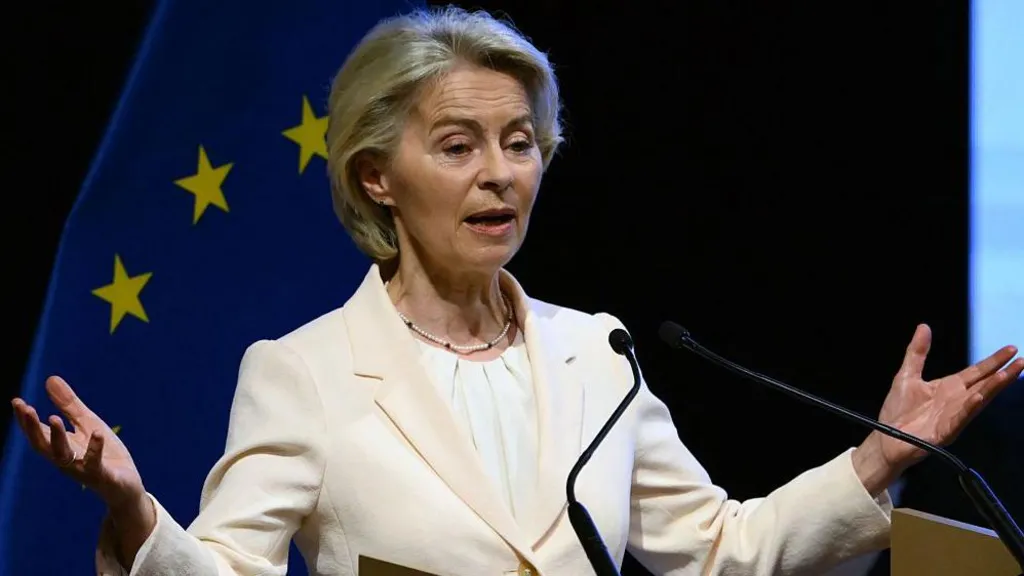
As President Trump threatens tariffs on European nations over Greenland, the EU weighs retaliation, legal action, and diplomatic pressure. Here are Europe’s options.
President Donald Trump’s threat to impose tariffs on eight European countries unless they support his plan to acquire Greenland has sent shockwaves across Europe.
On Saturday, the U.S. leader announced that a 10% tariff on imports from Denmark, Norway, Sweden, France, Germany, the UK, the Netherlands, and Finland would take effect on February 1, potentially rising to 25% by summer if no agreement is reached. It remains unclear whether these new duties would be added on top of existing levies.
France and Germany have already signalled that the European Union must be prepared to respond if Washington follows through. But what tools does Europe actually have?
The most direct option is for the EU to impose counter-tariffs on American goods. Brussels has used this approach before during past trade disputes with Washington, targeting politically sensitive U.S. exports such as agricultural products, motorcycles, and bourbon.
Reports suggest the EU is already considering a retaliatory package worth up to €93 billion, aimed at pressuring U.S. industries and lawmakers to push back against the White House.
Europe could challenge the tariffs through the World Trade Organization (WTO), arguing that the measures violate international trade rules. While this route is slower, it provides legal legitimacy and could strengthen Europe’s position in global trade forums.
However, WTO rulings can take years, and enforcement depends on political will—meaning this option may not offer immediate relief.
European leaders may attempt to defuse the crisis through diplomacy, engaging both the White House and U.S. lawmakers. The goal would be to frame the Greenland issue as a security and sovereignty matter that should be addressed through NATO and international cooperation, rather than trade coercion.
This approach could include rallying allies such as Canada and Japan to apply collective pressure on Washington.
Rather than broad tariffs, the EU could design highly targeted measures aimed at key U.S. sectors—technology, defence, or agriculture—maximising political impact while limiting economic damage at home.
This strategy has been effective in past disputes, where carefully chosen countermeasures forced negotiations without escalating into a full-blown trade war.
Perhaps Europe’s most important response will be political unity. By presenting a coordinated front, EU member states can prevent Washington from exploiting divisions and ensure that no single country is isolated.
France and Germany have already urged collective action, warning that fragmentation would weaken Europe’s leverage.
Trump’s tariff threat ties trade policy to geopolitical ambition in an unprecedented way. For Europe, the challenge is to respond firmly without triggering a spiral of retaliation that could damage already fragile economic growth.
Whether through counter-tariffs, legal action, or diplomacy, Brussels must now decide how to defend European interests—while keeping the door open for de-escalation.
Less than six months ago, the United States and the European Union struck a deal intended to stabilise transatlantic trade and restore confidence for businesses and consumers.
European Commission President Ursula von der Leyen left talks with President Trump in Scotland with a compromise: a 15% tariff on EU exports to the U.S.—far lower than the 30% Washington had initially threatened. As part of the negotiations, Brussels suspended a sweeping package of counter-tariffs while final details were being finalised.
That package, prepared as a fallback, covers a wide range of American exports—from livestock and aircraft components to whiskey—worth €93 billion (£80bn; $108bn).
The agreement was due to be ratified by the European Parliament next week. But Trump’s fresh threat to impose new tariffs over Greenland has cast the deal into doubt. Within hours, influential German MEP Manfred Weber declared that approval was “not possible at this stage.”
If the EU refuses to sign off on the agreement or extend the suspension, those tariffs on U.S. goods will automatically come into force on February 7—a move that could spark political backlash against Trump from American exporters reliant on European markets.
As for Trump’s proposal to target only certain EU countries, the European Commission has warned that such selective tariffs would be extremely difficult to implement. Goods often cross multiple EU borders before being exported to the U.S., making country-specific levies impractical.
Commission spokesperson Olof Gill said Brussels would do “everything necessary to protect EU economic interests,” but cautioned that tariffs ultimately harm businesses and consumers on both sides of the Atlantic.
Beyond conventional tariffs, the EU holds a far more powerful weapon: the Anti-Coercion Instrument (ACI)—often dubbed the “trade bazooka.”
The ACI allows the EU to respond to what it views as economic blackmail by non-EU countries. It is designed to counter attempts to pressure the bloc or its member states into abandoning their “legitimate, sovereign choices.”
Under this law, the EU can deploy an array of measures, including:
In extreme cases, it could effectively block access to large parts of the single market—overriding existing international agreements.
However, this is considered a nuclear option. Its true purpose is deterrence: to bring adversaries to the negotiating table. Using it outright could inflict serious economic damage within the EU itself, making it a last resort.
It is also far from immediate. The process involves:
Even if Brussels acted today, it could take a year before the “bazooka” is actually fired.
For now, Europe faces a delicate balancing act—defending its interests while avoiding a full-scale trade war that could weaken already fragile economic growth on both sides of the Atlantic.