Physical Address
304 North Cardinal St.
Dorchester Center, MA 02124
Physical Address
304 North Cardinal St.
Dorchester Center, MA 02124

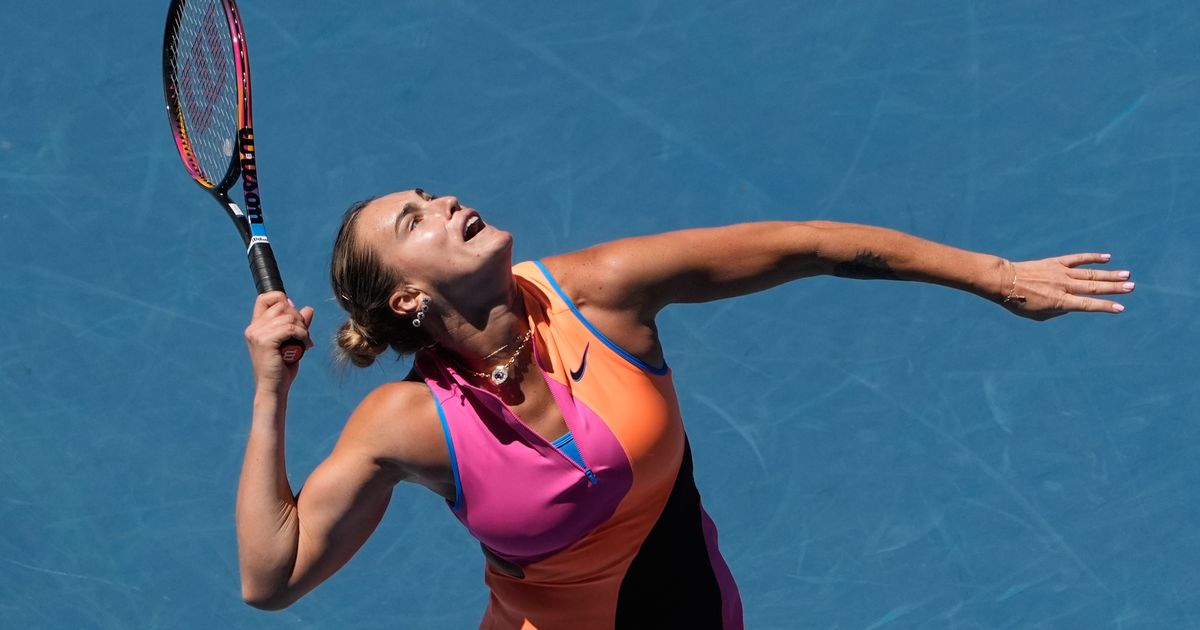
World number one Aryna Sabalenka battled through emotional turbulence to defeat Anastasia Potapova and reach the Australian Open fourth round, showcasing new mental strength.
World number one Aryna Sabalenka admitted she was “emotionally all over the place” after surviving a dramatic test against Anastasia Potapova to reach the fourth round of the Australian Open.
The two-time champion in Melbourne appeared to be cruising early on, racing into a commanding position at one set up and 4–0 ahead. At that point, the match looked like another routine outing for the Belarusian, who entered the tournament as one of the overwhelming favourites for the title.
But what followed was a reminder that even the most dominant players are vulnerable.
Potapova, ranked 55th in the world, mounted a spirited comeback that exposed Sabalenka’s inner struggle. The top seed later admitted she felt “disconnected from my body” as momentum swung sharply. Suddenly, the once-comfortable lead vanished, and Sabalenka found herself under intense pressure, forced to save four set points before eventually grinding out a 7-6 (7-4), 7-6 (9-7) victory in two hours and two minutes.
After the match, Sabalenka was candid in her assessment. This, she said, was the kind of encounter she would have lost earlier in her career.
“Aryna five years ago would be focusing too much on the way she feels and completely lose these matches,” she reflected.
Her words captured the essence of her evolution. Once known as much for emotional volatility as for raw power, Sabalenka has spent years reshaping her mental game. She previously worked with a psychologist to better manage the pressure that comes with playing for the biggest prizes in tennis.
That work is now paying dividends.
“I learned that it doesn’t really matter how you feel,” she said. “It’s all about your mentality, your mental strength to be there, try your best, return the ball ugly with terrible technique and your body being completely disconnected.
“When you see that things are not working, the only tactic you have is to fight.”
Those sentiments were borne out on court. With her timing off and rhythm disrupted, Sabalenka abandoned the pursuit of perfection. Instead, she dug in, scrambled, and competed. It was not pretty, but it was effective.
The victory also extended one of the most remarkable streaks in modern tennis. Sabalenka has now won 19 consecutive tie-breaks at Grand Slam tournaments—the longest run by a woman in the Open era. Among active singles players, only Novak Djokovic has matched that feat, achieving the same between 2005 and 2007.
It is a statistic that underlines her growth. Tie-breaks are moments of maximum tension, where technique, nerve, and belief collide. Sabalenka’s dominance in these high-pressure scenarios is a testament to how far she has come.
Her career trajectory over the past three seasons has been extraordinary. She has reached at least the semi-finals in 13 of her last 16 Grand Slam appearances, winning four major titles in that span. Last year, however, served as a reminder that even champions can stumble. She lost two Grand Slam finals—first to Madison Keys in Melbourne, then to Coco Gauff at the French Open, where she committed 70 unforced errors.
Those defeats reinforced an old truth: Sabalenka’s biggest opponent is often herself.
By her own admission, she can “lose control” of her emotions when the stakes are highest. But matches like this one against Potapova show a player learning to coexist with imperfection rather than be destroyed by it.
“I’m super happy with my mentality today,” she said. “I think it was the only thing that really helped me get the win.
“It was one of those days you have to fight to try and get the ball back. Emotionally I was all over the place. I was trying to figure out how to connect my body.
“It seemed like everything was working separately; my brain was somewhere else, my arms were going one direction. Magically, I was able to get this win.”
For Sabalenka, that “magic” was resilience.
The significance of the moment extends beyond a single match. Champions are not defined by how they play on their best days, but by how they survive on their worst. On a day when her timing deserted her and her confidence wavered, Sabalenka found another gear—one rooted not in power, but in persistence.
Her reward is a fourth-round meeting with 19-year-old Canadian Victoria Mboko. On paper, Sabalenka will again be the overwhelming favourite. But the lesson from her Potapova scare is clear: at the elite level, nothing is guaranteed.
What separates the great from the good is the ability to endure discomfort and still emerge victorious.
Sabalenka’s journey in Melbourne continues, not just as a test of skill, but as a measure of her emotional mastery. Each hard-fought win reinforces the transformation from a supremely talented player into a complete champion.
On this evidence, the world number one is no longer just hitting her way to trophies. She is thinking, adapting, and—most importantly—fighting her way there.