Physical Address
304 North Cardinal St.
Dorchester Center, MA 02124
Physical Address
304 North Cardinal St.
Dorchester Center, MA 02124

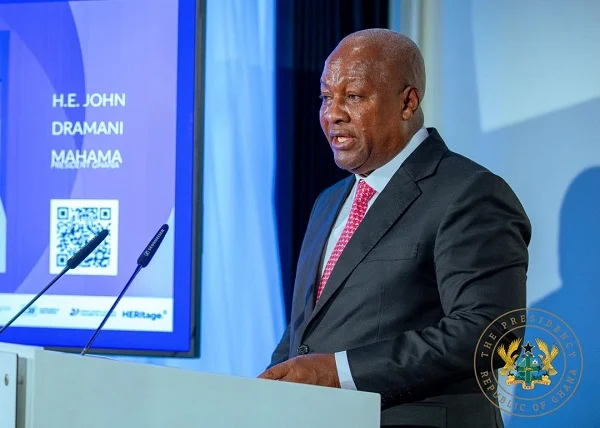
At Davos, President John Mahama urges African leaders to unite and take charge of the continent’s destiny, unveiling the Accra Reset as a bold framework for Africa’s renaissance.
President John Dramani Mahama has issued a powerful call for African unity, urging leaders across the continent to work together to ignite the renaissance Africans have long yearned for. Speaking in Davos, Switzerland, on the sidelines of the World Economic Forum, President Mahama warned that Ghana’s economic recovery would be hollow if Africa as a whole continued to lag behind.
“However admirable Ghana’s turnaround story is, we cannot be a jewel in the dirt,” he said. “We must work together as Africa. We must knit together the patchwork of success stories.”
The President made the remarks at a high-level event dubbed Accra Reset, an initiative he is championing to introduce a bold and actionable framework for transforming global governance. The Accra Reset seeks to reshape how the world collaborates in a turbulent, post-Sustainable Development Goals (SDG) era, ensuring that global systems are fit for purpose and inclusive of the Global South.
According to President Mahama, Africa’s greatest challenge is not a lack of resources or talent, but a failure of systems that keep the continent dependent on others for critical functions such as security, healthcare, and education.
“Too many African countries remain dependent on others for their security, their health systems, and their education,” he observed. “Despite supplying the world with critical minerals, Africa captures almost none of the value.”
He reminded his audience that Africa has demonstrated leadership on the global stage before. When HIV/AIDS ravaged the world two decades ago, it was African leaders who pushed for the creation of the Global Fund—an initiative that went on to save millions of lives across Africa and beyond.
Yet, with the United States cutting funding to the United Nations and other international institutions, President Mahama warned that the world now faces an unpredictable future.
“This is why Africa must be responsible for its destiny,” he declared.
The President described the continent as facing a “pandemic of unfulfilled potential,” where millions of young people are without jobs, health systems collapse at the first sign of crisis, and economies extract resources without building anything lasting.
“If we could mobilise the world to fight a disease,” he asked, “why can’t we mobilise to fight poverty, dependency, and the systems that keep brilliant young Africans locked out of the future?”
In his view, the world is entering a new era—one defined by competition, innovation, and self-reliance.
“In this fast-changing world, we are entering an era where countries must compete, innovate, and build—or be left behind,” he said.
Africa’s young population, he emphasized, is both the continent’s greatest strength and its most urgent responsibility. These “brilliant and hungry” young people are running out of patience, watching their leaders, and waiting for decisive action.
President Mahama urged African leaders to respond with bold investments in skills, industrialisation, and accountable governance.
“To this end, we must invest in the skills of our young people, build together, industrialise, and be accountable to our citizens,” he said.
He explained that the Accra Reset is designed to create a new architecture for cooperation—one in which countries of the Global South are not passive recipients of programmes but active co-designers.
“The Accra Reset is building the architecture for a new kind of cooperation,” he said. “One where Global South countries don’t just receive programmes but co-design them with partners, and don’t just attract investment but shape it around their priorities.”
Beyond economics, President Mahama framed the initiative as a moral and generational mission. He said African leaders must leave behind a continent where young people no longer feel compelled to risk their lives crossing the Mediterranean in search of opportunity.
“We want to leave systems that work, industries that thrive, and nations that stand tall,” he said. “Ghana can’t do it alone. Africa can’t do it alone.”
His message was a direct call to fellow leaders and global partners alike.
“This is a call to every leader,” he declared. “If you believe in a world where prosperity is shared, not just based on narrow interests, join us. If you believe the Global South deserves partnership, not pity, join us.”
He envisioned a future where the next chapter of human progress is written not only in traditional global capitals, but in African cities.
“If you believe the next chapter of human progress will be written in Accra, Nairobi, Kigali, Abuja, and Cairo, join us,” he said. “The Accra Reset is not seeking permission. We’re building momentum.”
Observers at Davos described the speech as one of the most direct and ambitious calls for African self-determination heard at the forum in recent years. By tying Ghana’s progress to the fate of the entire continent, President Mahama reframed national success as inseparable from regional advancement.
The Accra Reset, in this sense, is not merely a policy platform—it is a statement of intent. It challenges African leaders to move beyond isolated achievements and build a collective future, and it challenges global partners to engage Africa as an equal architect of solutions.
As the world grapples with shifting power dynamics, climate shocks, and economic uncertainty, Mahama’s message was clear: Africa must no longer wait for rescue. The continent must design its own destiny—and invite the world to build with it, not for it.