Physical Address
304 North Cardinal St.
Dorchester Center, MA 02124
Physical Address
304 North Cardinal St.
Dorchester Center, MA 02124

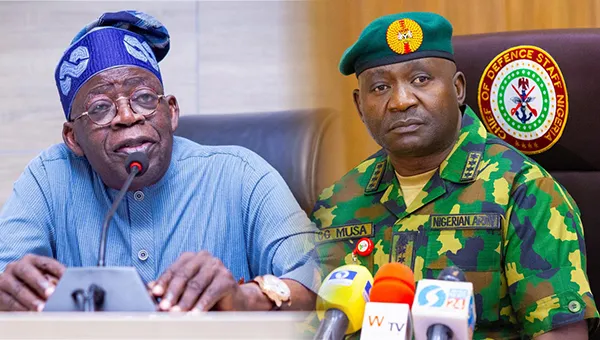
Sixteen Nigerian officers are set to face a military court over alleged plans to overthrow President Bola Tinubu, reviving sensitive memories of Nigeria’s coup-filled past and raising questions about civil-military relations.
Nigeria has once again been thrust into uncomfortable territory as the armed forces confirm that a group of officers will face a military court over allegations of plotting to overthrow the government of President Bola Ahmed Tinubu.
In a statement released by the military, authorities disclosed that some of the 16 officers arrested in October last year will be tried before a military judicial panel following the conclusion of internal investigations. The officers were initially detained for what the armed forces described at the time as “acts of indiscipline and breaches of service regulations.”
When news of their arrest first emerged, rumours of a coup attempt spread quickly across the country. The military swiftly dismissed those claims, insisting that there was no plot to seize power. Months later, however, the tone has shifted. While not all of the detained officers will be charged, the armed forces have now acknowledged that the matter goes beyond routine disciplinary issues.
The implication is clear: elements within the ranks may have crossed a line that strikes at the heart of Nigeria’s constitutional order.
Few accusations carry as much historical weight in Nigeria as coup plotting. Between 1966 and 1993, the country experienced a succession of military takeovers that reshaped its politics, economy, and social fabric. Generations of Nigerians grew up under military rule, with civil liberties suspended and political life tightly controlled.
The return to democratic governance in 1999 marked a turning point. Since then, Nigeria has worked to entrench civilian supremacy over the armed forces—a core principle of modern democracy.
Against this backdrop, even the hint of a coup attempt sends shockwaves through the public consciousness.
It is this history that makes the current development so sensitive. Allegations that officers may have contemplated overthrowing an elected government revive memories of an era many Nigerians hoped was permanently behind them.
When the 16 officers were arrested last October, the military framed the issue as one of internal misconduct. The language was cautious, emphasizing discipline and adherence to service regulations. This approach appeared designed to reassure the public and avoid panic.
Yet investigations have since led to a more serious conclusion.
According to the armed forces, the inquiry revealed sufficient grounds for some of the officers to be referred to a military court. While details of the alleged plot remain scarce, the shift from administrative discipline to judicial proceedings suggests the offences are considered grave.
It also reflects the military’s desire to be seen as acting decisively and transparently.
By allowing the matter to proceed through formal legal channels, the armed forces send two important messages:
This is a critical signal at a time when coups in parts of West Africa have raised fears about democratic backsliding across the region.
Nigeria’s neighbours—Mali, Burkina Faso, Niger, and Guinea—have all experienced military takeovers in recent years. These developments have unsettled regional stability and challenged democratic norms within ECOWAS.
In this environment, Nigeria’s internal stability carries continental significance. As Africa’s most populous nation and one of its largest economies, Nigeria has long positioned itself as a defender of constitutional governance in West Africa.
An alleged coup plot within its own military therefore strikes at the credibility of that stance.
The government’s handling of the situation will be closely watched, both at home and abroad. A transparent process, grounded in law, could reinforce Nigeria’s democratic credentials. Conversely, secrecy or political manipulation could fuel suspicion and erode trust.
For President Tinubu, the episode underscores the complex challenges of leadership in a diverse and politically charged environment.
His administration is grappling with economic reforms, security threats, and social pressures. The emergence of alleged disloyalty within the armed forces adds another layer of concern.
However, the fact that the military itself has acknowledged the issue and initiated legal proceedings may ultimately strengthen civilian authority. It demonstrates that the armed forces recognize their role within a democratic framework.
Rather than sweeping the matter under the rug, the decision to prosecute reflects institutional maturity—at least in principle.
It is important to note that Nigeria has not experienced a successful coup since the end of military rule. The country’s democratic institutions, though imperfect, have endured for over two decades.
This case does not necessarily signal imminent instability. Instead, it highlights the importance of vigilance.
Democracy is not defined by the absence of threats, but by how a society responds to them.
By confronting the allegations through legal and institutional channels, Nigeria has an opportunity to reaffirm a central lesson of its modern history: political power must flow from the ballot, not the barrel of a gun.
As the officers prepare to face a military court, the nation watches—not just for the outcome of a trial, but for what it reveals about the strength of Nigeria’s democratic resolve.
In a country shaped by coups, choosing law over force is more than procedure. It is a statement of who Nigeria is, and who it refuses to become again.
Join African360 WhatsApp Channel for more News update: https://whatsapp.com/channel/0029Vb7Oc6nGk1FpdCN0xn44