Physical Address
304 North Cardinal St.
Dorchester Center, MA 02124

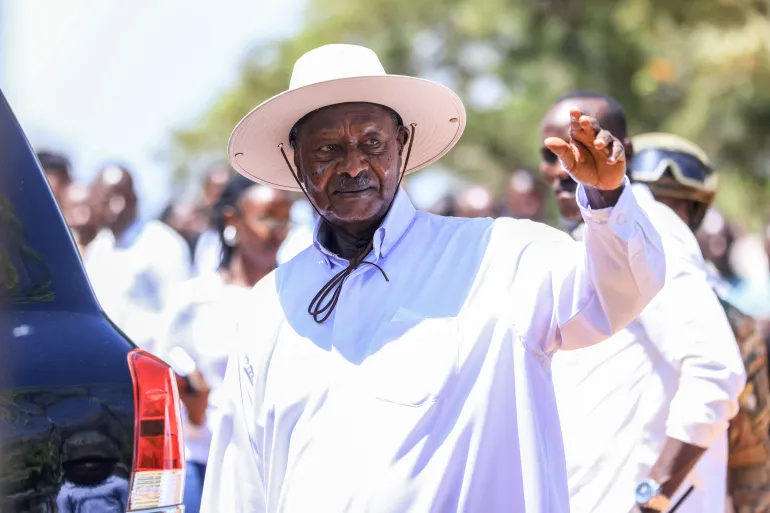
President Yoweri Museveni secures another landslide victory in Uganda’s election, while opposition cries foul and attention shifts to succession and the growing influence of his son.
For supporters of President Yoweri Museveni, his commanding victory in Uganda’s latest election confirms the enduring strength of a leader who has ruled for nearly four decades. Winning 72% of the vote—close to his record 74% in the country’s first direct presidential election in 1996—the 81-year-old has reinforced his claim to overwhelming national support.
Museveni, who came to power in 1986 after leading a rebel movement that toppled Milton Obote’s government, campaigned on continuity. He pointed to decades of relative stability and promised to guide Uganda toward middle-income status by 2030, framing the goal as the crowning achievement of what may be his final term.
Central to that vision is Uganda’s emerging oil industry. On the campaign trail, Museveni told voters that crude exports—expected to begin in October via a 1,443km pipeline to Tanzania’s port of Tanga—would drive double-digit economic growth.
Yet his victory has been fiercely contested. His main challenger, former pop star Bobi Wine, rejected the outcome as “fake,” claiming the process was neither free nor fair. Wine said he went into hiding after security forces raided his home. He accused authorities of disrupting his rallies with tear gas and live ammunition, alleging intimidation and ballot manipulation—claims the government has not addressed.
The results were a bitter setback for Wine. His vote share fell from 35% in 2021 to 25%, despite Uganda’s overwhelmingly young population, long viewed as his natural base. After two failed presidential bids, questions now surround his political future and whether sustained pressure from the state will erode his popular appeal.
Throughout the campaign, the contrast was stark: Wine embodied youthful impatience and change, while Museveni cast himself as the steady patriarch in uncertain times. According to official figures, voters chose experience over disruption.
But beyond the immediate outcome, attention is shifting to what comes next. Many observers have focused on the issue of succession—when and how Museveni will eventually step aside. Ugandan journalist and analyst Allan Kasujja cautions against expecting dramatic change.
“Political transformation in Uganda does not happen suddenly,” he says. “It unfolds gradually, and that process has been under way for some time.”
Viewed this way, the election appears less a turning point and more a ritual that legitimizes deeper shifts within the ruling National Resistance Movement (NRM) and the state apparatus it controls.
Those shifts became visible during a cabinet reshuffle in 2023 and were unmistakable during internal NRM elections in August 2025. What should have been routine party contests evolved into a struggle over positioning in a post-Museveni era, marked by factional bargaining and allegations of bribery.
Veteran figures from the old guard were edged out, replaced by newer faces widely regarded as loyal to Gen Muhoozi Kainerugaba—the president’s son and army chief. The process underscored the growing influence of a figure many see as the likely successor.
Sources close to the presidency say power at State House is becoming increasingly decentralized. Decisions once made directly by Museveni now pass through a close-knit circle of relatives and trusted associates. His eldest daughter, Natasha Karugire, reportedly manages his daily schedule. Foreign relations and military ties are handled by his half-brother, Salim Saleh. Economic policy is shaped by his son-in-law, Odrek Rwabwogo.
For the first time in Uganda’s modern history, all security matters—internal and external—fall under Gen Kainerugaba’s authority.
Given Uganda’s long tradition of military influence in politics, and the fact that Museveni himself rose through armed struggle, this concentration of power carries profound implications. It suggests that even without holding the presidency, Museveni’s son is already shaping the country’s future.
Uganda’s next chapter, it seems, is being written not only at the ballot box—but within the inner circles of power.