Physical Address
304 North Cardinal St.
Dorchester Center, MA 02124
Physical Address
304 North Cardinal St.
Dorchester Center, MA 02124
Ghana ranks as Africa’s seventh strongest financial market in the 2025 Absa Index, driven by a historic stock market rally, banking sector growth, and improving macroeconomic stability.
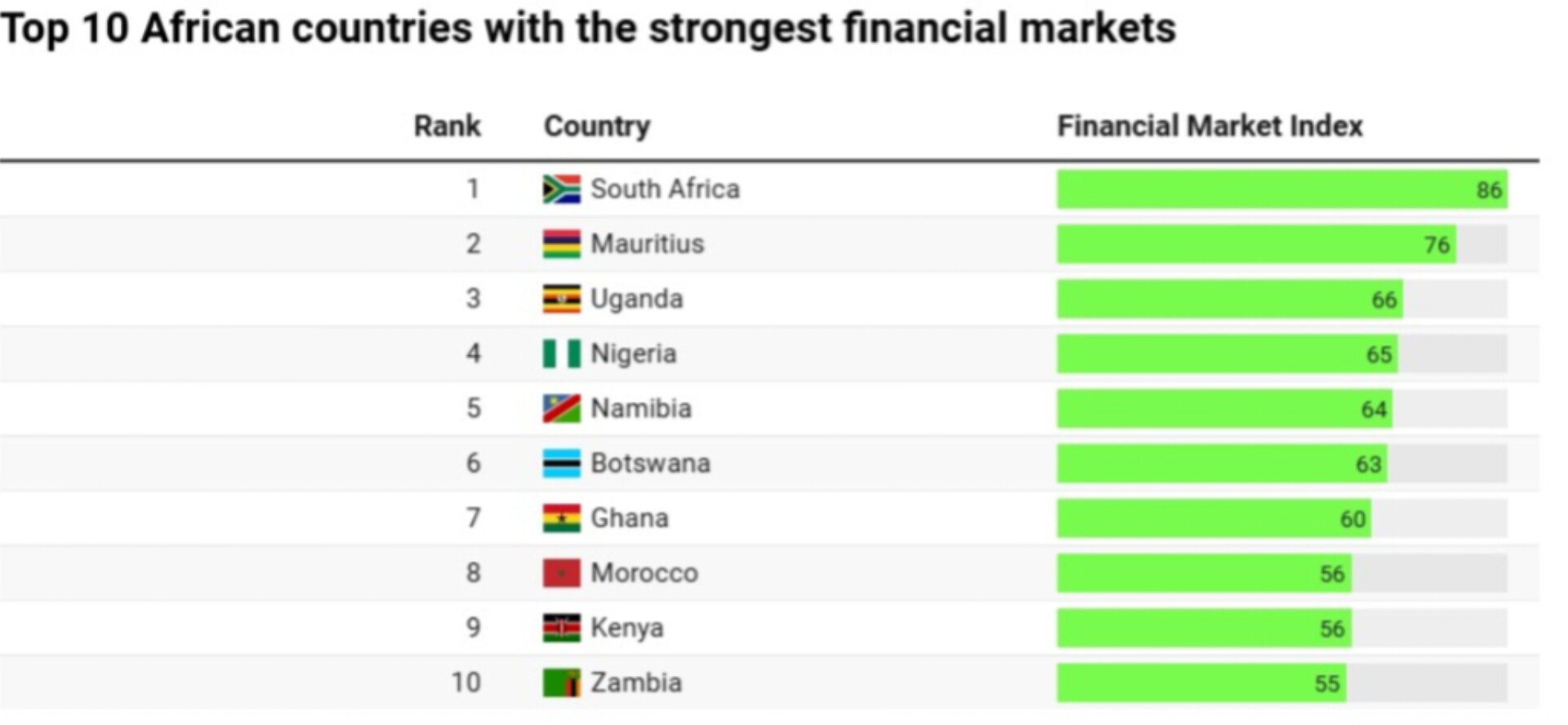
Ghana’s financial sector has received a major vote of confidence on the continental stage. According to the 2025 Absa Africa Financial Markets Index, the country has been ranked as the seventh strongest financial market in Africa, earning a score of 60 on the index.
In the rankings, Ghana placed behind Botswana, Namibia, Nigeria, Uganda, Mauritius and South Africa, with South Africa retaining its long-held position as the continent’s strongest financial market. While seventh place may appear modest at first glance, the story behind the ranking is far more encouraging. It reflects a period of recovery, reform, and renewed investor confidence—driven largely by the exceptional performance of the Ghana Stock Exchange (GSE) in 2025.
After years of economic turbulence, debt restructuring, and currency instability, Ghana’s financial markets are showing signs of resilience and revival.
The most powerful driver of Ghana’s improved standing is the remarkable turnaround on the Ghana Stock Exchange. In 2025, the GSE emerged as the second-best performing stock market in Africa, marking one of the strongest rallies in its history.
The GSE Composite Index surged by an extraordinary 79.40 per cent, closing the year at 8,770.25 points. Even more striking was the performance of the Financial Stock Index, which rose by 95.19 per cent, its strongest showing since 2004.
This rally was not built on speculation alone. It reflected renewed confidence following Ghana’s debt restructuring programme, improved macroeconomic management, and clearer policy direction. Investors—both domestic and foreign—responded to signs of stability, fiscal discipline, and a more predictable economic environment.
For ordinary Ghanaians, these gains are more than numbers on a screen. They represent growing opportunities for wealth creation, pension growth, and long-term savings. For businesses, they signal easier access to capital. For the state, they indicate a healthier environment for financing development.
Beyond the stock market, Ghana’s banking sector also recorded solid expansion in 2025. By the end of December, total deposits stood at GH¢325.3 billion, while total assets reached GH¢446.9 billion. These figures represent growth rates of 17.8 per cent and 21.5 per cent respectively.
This growth suggests increasing public confidence in the banking system and a gradual return of liquidity into formal financial channels. A robust banking sector is the backbone of any strong financial market. It mobilises savings, supports credit to businesses, and provides the infrastructure for investment and trade.
The Absa Africa Financial Markets Index evaluates countries based on transparency, accessibility and openness, offering a comparative view of how African nations are strengthening their capital markets. Ghana’s rise to seventh place reflects progress across these dimensions, particularly in market depth, investor access, and institutional development.
The 2025 edition of the index goes beyond rankings. It situates Africa’s financial markets within a rapidly shifting global environment, shaped in part by renewed protectionism and elevated trade tariffs under United States policies.
While the report acknowledges that overall performance across the continent appears subdued, it cautions against pessimism.
“On a headline basis, the last year may feel like a bit of a disappointment. Just 10 of the 29 countries in the 2025 index saw their overall scores improve,” the report notes.
Yet, a deeper look reveals sustained progress—particularly in foreign exchange reforms, product diversification, and climate-related financial initiatives.
In this context, Ghana’s position becomes even more significant. At a time when many markets are struggling to adapt to global uncertainty, Ghana has managed to strengthen its financial fundamentals and attract renewed interest.
One of the report’s most important insights is the role of currency stability in shielding African economies from external shocks. Volatile exchange rates amplify the impact of global interest rate hikes, trade disruptions, and capital flight.
The index argues that a more stable currency environment would dramatically reduce vulnerability across African economies.
This view is echoed by Ahmed Attout, Director of Financial Sector Development at the African Development Bank (AfDB), who emphasised the importance of local currency financing.
“Long-term local currency financing is key to economic development,” he said.
According to Mr Attout, when financial systems effectively mobilise domestic resources and allocate capital efficiently, households gain more savings and investment options. Businesses and governments, in turn, are better positioned to fund long-term projects such as infrastructure, energy and industrial development.
Countries with strong domestic capital markets, he noted, are more resilient to external shocks—including currency volatility and sudden changes in global interest rates.
For Ghana, this message is clear: sustaining the current momentum requires continued reform, deeper capital markets, and policies that strengthen confidence in the cedi.
Ghana’s seventh-place ranking is not an endpoint. It is a signal.
It signals that the difficult choices of recent years—debt restructuring, fiscal discipline, and institutional reform—are beginning to bear fruit. It signals that investors are willing to return when stability is restored. And it signals that Ghana’s financial markets can once again play their role as engines of growth.
But the ranking also carries a challenge. To climb higher, Ghana must:
Financial markets do not thrive on announcements alone. They grow on trust, predictability, and long-term vision.
Ghana’s return to prominence on Africa’s financial map is encouraging. The task now is to turn that progress into permanence—so that the country’s markets do not merely recover, but lead.
Join African360 WhatsApp Channel for more News update: https://whatsapp.com/channel/0029Vb7Oc6nGk1FpdCN0xn44