Physical Address
304 North Cardinal St.
Dorchester Center, MA 02124
Physical Address
304 North Cardinal St.
Dorchester Center, MA 02124

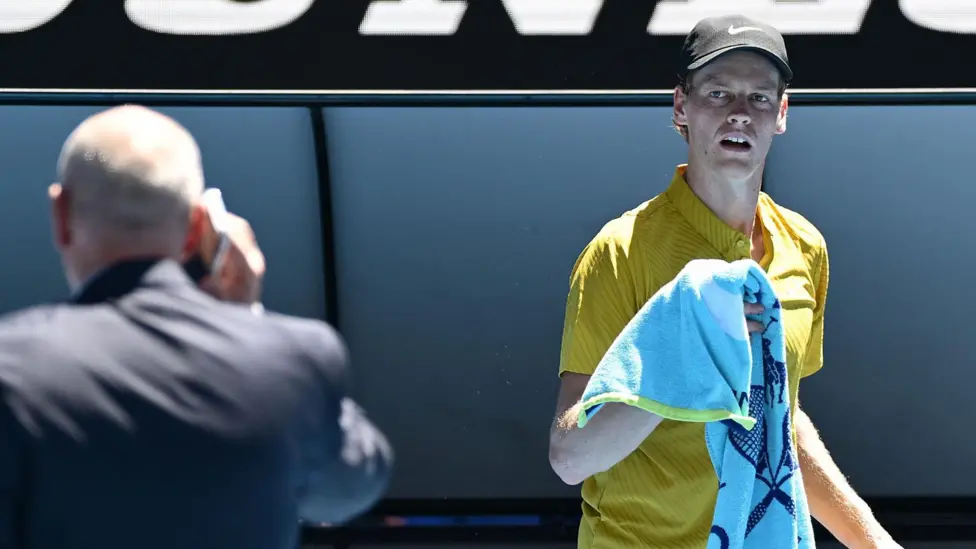
Jannik Sinner’s Australian Open title defense nearly collapsed in 40°C heat — until the tournament’s heat rule saved him. A dramatic third-round match became a lesson in survival, science, and modern tennis.
Melbourne is famous for many things — vibrant culture, electric sports crowds, and unforgiving summer heat. But on this scorching Australian Open day, the city reminded everyone why it has earned the nickname “four seasons in one day.” As temperatures surged toward 40°C, tennis transformed from a test of skill into a brutal examination of endurance.
And no player felt that more than world number one Jannik Sinner.
The Italian star entered the tournament chasing history: a third consecutive Australian Open title. Everything pointed toward another dominant run — until he stepped onto Rod Laver Arena for his third-round match against American underdog Eliot Spizzirri, ranked outside the world’s top 80.
What followed was one of the most dramatic survival stories of the tournament.
By midday, Melbourne Park shimmered under a blazing sun. Spectators sought shade, misting tunnels, and hydration stations. Ball kids crouched on their shoes instead of the court to avoid burning their palms. Fans were warned repeatedly to take care in the heat.
Despite efforts by tournament organizers to bring play forward, it was clear the day would be extreme.
Sinner and Spizzirri walked onto court at around 12:30 p.m. The atmosphere was tense, the air heavy. Chair umpire Fergus Murphy reminded both players of the tournament’s heat protocols — a warning that would soon prove pivotal.
Spizzirri, fearless and fresh, stunned the arena by taking the first set 6–4. Sinner responded in the second, but by the start of the third set, something was wrong.
The defending champion could barely move.
He began cramping. His stride shortened. He grimaced between points. At 3–1 down in the third set, Sinner looked finished — physically drained and mentally vulnerable. The upset felt inevitable.
Then, in a moment that changed everything, the heat stress scale reached its maximum level of five.
The match was stopped.
The Australian Open uses a sophisticated heat stress scale that combines four elements:
When the scale reaches level five, play is suspended on show courts so the roof can be closed and the arena cooled.
Crucially, matches stop at the end of an even-numbered game.
Seconds after the fourth game concluded, Sinner — visibly struggling — was allowed to leave the court. The roof began closing. Cool air flowed in. An eight-minute delay followed.
Spizzirri stood bewildered, shaking his head.
Sinner later admitted the truth:
“I got lucky with the heat rule.”
And he was right.
That brief escape changed the match. Sinner returned rejuvenated. He broke back immediately. His movement improved. His timing sharpened. Within minutes, the narrative flipped.
He took the third set. Then the fourth.
Final score: 4–6, 6–3, 6–4, 6–4.
A match that seemed lost became a statement of survival.
Before the stoppage, Sinner was battling not just an opponent but his own body. After it, he was once again the composed, ruthless champion fans know.
As the roof cooled Rod Laver Arena, temperatures dropped to around 26°C. Sinner no longer sat at changeovers — he stood, breathed deeply, and reasserted control. His ball-striking overwhelmed Spizzirri, whose dream run ended not by error, but by circumstance.
It was a legal intervention. The rules were followed precisely. But it left a lingering question:
Should extreme heat decide matches — or save them?
This was not just Sinner’s story. It was the Australian Open’s.
Play on outside courts was suspended until evening. Nearly 80,000 spectators were warned to stay vigilant. Organizers rolled out extraordinary measures:
Ball kids worked shorter shifts. Junior players retired from matches with cramp. Even elite athletes felt the strain.
American star Jessica Pegula admitted players are “used to” heat — but not like this. Defending women’s champion Madison Keys was grateful her match was scheduled early.
Aryna Sabalenka summed it up best:
“The weather being crazy means a lot of adjustment on the strings and your approach to the match. It’s a rollercoaster.”
And the rollercoaster is far from over. Forecasts predict more 40°C days as the tournament enters its decisive stages.
Critics may say Sinner was rescued.
Supporters will argue that champions survive when others fall.
The truth lies somewhere in between.
The heat rule exists for safety, not strategy. Without it, players risk serious medical harm. Yet, its timing — stopping only at even games — created a dramatic swing that undeniably favored Sinner.
But luck alone does not win Grand Slams.
Sinner still had to:
Many players have been given a second chance. Few seize it.
This match symbolizes tennis in a warming world.
Climate change is no longer an abstract concern — it is shaping outcomes. It affects scheduling, performance, safety, and fairness. The sport is adapting in real time.
Sinner’s survival is not just a story of fortune. It is a reminder that elite sport now exists at the mercy of nature.
On this day in Melbourne, the heat nearly dethroned a champion.
Instead, it paused — just long enough for him to rise again.
And in that pause, Jannik Sinner kept his dream alive.
Follow African360 WhatsApp Channel for more update: https://whatsapp.com/channel/0029Vb7Oc6nGk1FpdCN0xn44