Physical Address
304 North Cardinal St.
Dorchester Center, MA 02124
Physical Address
304 North Cardinal St.
Dorchester Center, MA 02124

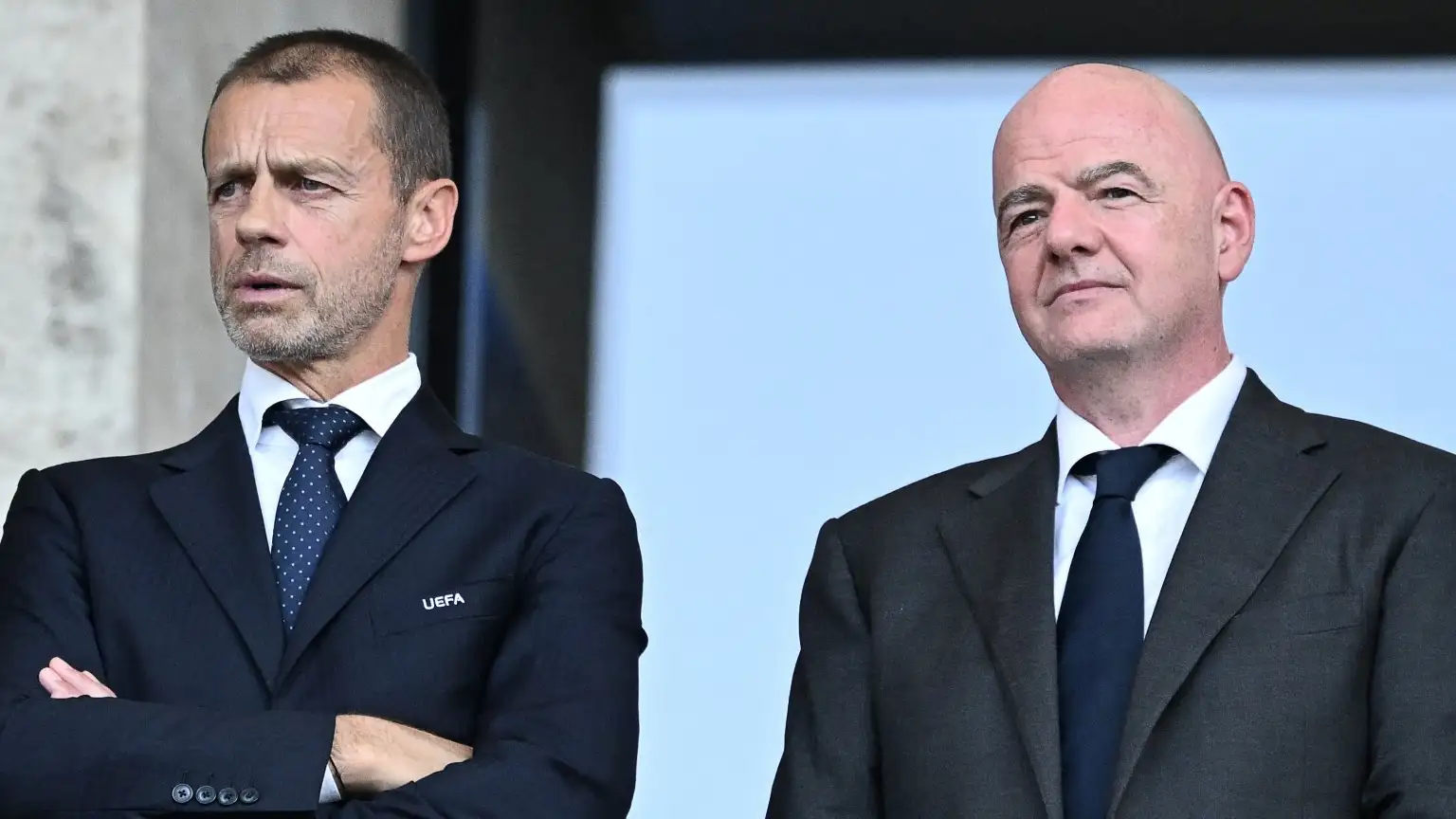
UEFA President Aleksander Čeferin has launched a fierce public criticism of FIFA President Gianni Infantino, using the famous “The Emperor’s New Clothes” story to attack FIFA’s handling of its now-abandoned commercial investment plan.
Speaking at the European Football Clubs (EFC) General Assembly in Copenhagen on Tuesday, September 29, 2026, Čeferin accused FIFA of using terms such as “development”, “democratisation” and “consultation” to describe a process he strongly disagrees with.
Although Čeferin did not repeatedly name Infantino directly during the passage, his comments were clearly directed at the FIFA president and the controversial FIFA Forward Enterprise (FFE) proposal.
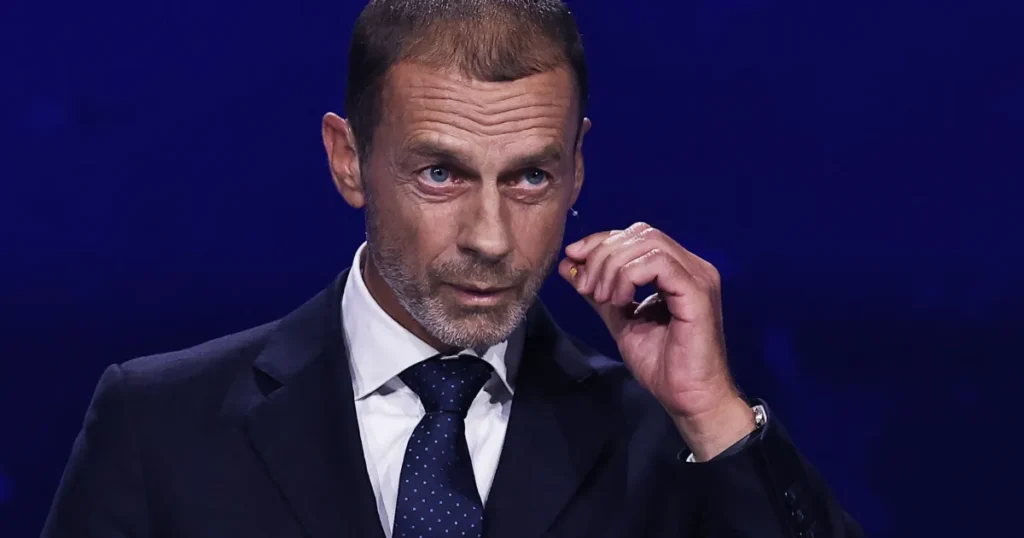
Čeferin referred to Danish author Hans Christian Andersen’s famous fairy tale The Emperor’s New Clothes.
He told football executives that the story describes an emperor who is convinced that he is wearing magnificent clothes until a child points out what everyone can see.
Čeferin then applied the analogy to the current dispute within world football.
He argued that convenient language cannot change what he considers uncomfortable realities surrounding FIFA’s decision-making.
His remarks represented one of the strongest public attacks yet from the UEFA president against Infantino.
The FIFA Forward Enterprise proposal was designed to establish a FIFA-controlled commercial subsidiary that would hold commercial rights connected to major competitions, including the men’s and women’s World Cups and the Club World Cup.
The proposal would have allowed private investors to acquire up to 20% of the entity.
Infantino presented the project as a potential way to increase FIFA’s commercial revenues and generate additional funding for football development around the world.
FIFA said the proposal remained subject to consultation and approval processes. In July, Infantino described the proposed subsidiary as an opportunity to increase investment in football infrastructure, national teams and opportunities for young players.
The proposal was subsequently abandoned following opposition from several influential football stakeholders.
Čeferin directly questioned FIFA’s description of the project as a development initiative.
He argued that selling a portion of football’s future commercial rights should not automatically be described as “development” simply because that term is used.
He also challenged FIFA’s description of its consultation process, arguing that consultation should involve meaningful participation rather than presenting stakeholders with decisions that have already effectively been made.
Reuters reported that Čeferin also criticised what he described as secrecy surrounding the process.
In one of the most striking parts of his speech, Čeferin asked club executives to imagine a senior official secretly negotiating away control of a club’s most valuable assets without informing its board, players or supporters.
He then asked the executives what their boards would do if they discovered such a deal.
Čeferin used the hypothetical scenario to argue for stronger accountability and transparency within football’s governing structures.
He concluded that repeated controversies should eventually lead football stakeholders to say “enough.”
Čeferin’s remarks come at a time of increasingly public tension between FIFA and UEFA.
The disagreement over the Forward Enterprise proposal is only one part of the broader dispute.
FIFA has accused UEFA of conducting a misinformation campaign and has pushed back against criticism surrounding the abandoned commercial project. UEFA, meanwhile, has sought access to documents relating to the proposal.
The dispute has also emerged alongside discussions about FIFA’s financial reserves and how much money should be distributed to national football associations.
UEFA and CONCACAF have called for increased distributions from FIFA’s reserves, with a proposal for at least $10 million for each of FIFA’s 211 member associations during the 2027–2030 cycle. Infantino has said he supports the greatest level of additional funding that can responsibly be delivered, while stopping short of committing to a specific amount.
The FIFA Council is expected to consider the funding proposals on October 15, 2026.
The dispute is also unfolding ahead of the next FIFA presidential election.
Infantino is seeking a fourth term, with the election scheduled for March 2027. Potential opposition to his leadership and disagreements over FIFA governance have therefore become increasingly significant in international football politics.
Meanwhile, EFC chairman Nasser Al-Khelaifi said in Copenhagen that he has no interest in becoming FIFA president, despite previously being discussed as a possible candidate.
The latest exchange between Čeferin and Infantino illustrates the increasingly open disagreement over how global football should be governed, how commercial rights should be managed and how revenues should be distributed among the game’s stakeholders.
For now, the FIFA Forward Enterprise proposal has been shelved, but the dispute surrounding the project continues to shape relations between FIFA, UEFA and Europe’s leading clubs.
Follow the African360 Sports channel on WhatsApp: https://whatsapp.com/channel/0029VbDrVn8HrDZe4uoLW42r