Physical Address
304 North Cardinal St.
Dorchester Center, MA 02124
Physical Address
304 North Cardinal St.
Dorchester Center, MA 02124

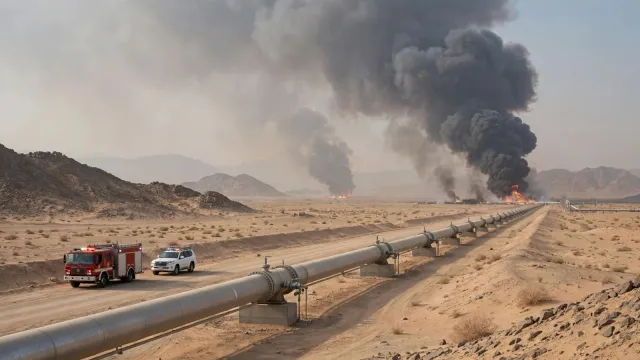
Saudi Arabia has temporarily shut down a critical oil pipeline after it was targeted by drones launched from Iraq, adding another major threat to global energy supplies as the wider Middle East conflict continues to escalate.
The attack on the 1,200-kilometre East-West oil pipeline comes as fighting and instability spread across several strategic energy and shipping routes in the region.
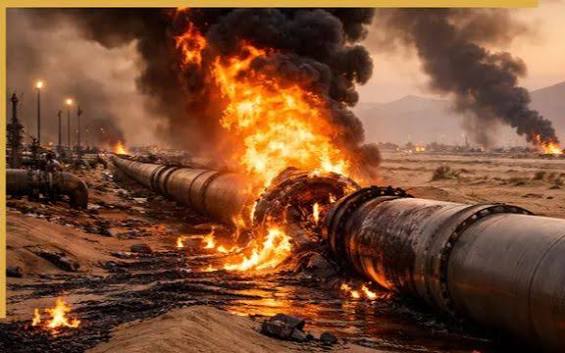
Saudi Arabia said the pipeline was closed as a precaution after the attack caused damage and injuries. The full extent of the damage and its impact on oil exports was still being assessed.
The development is particularly significant because the pipeline provides Saudi Arabia — the world’s largest crude oil exporter — with an alternative route for moving oil to global markets without relying on the Strait of Hormuz.
The East-West pipeline stretches approximately 1,200 kilometres (745 miles) across Saudi Arabia.
According to Reuters, the pipeline has recently been carrying around 4 million to 5 million barrels of oil per day, equivalent to roughly 4% to 5% of global oil supply.
That makes any prolonged disruption potentially significant for the international oil market.
The pipeline has become particularly important during the current crisis because disruptions around the Strait of Hormuz have already affected normal Gulf oil flows.
Its closure therefore removes one of Saudi Arabia’s most important alternative routes at a time when global energy markets are already under severe pressure.
Iraq has acknowledged that the drone attack originated from its territory.
Following an investigation, the Iraqi government removed the military commander responsible for operations in Maysan province, a region in southern Iraq bordering Iran.
The move signals Baghdad’s concern about attacks being launched from Iraqi territory against neighbouring countries.
Iraq has also taken additional security measures, including the closure of a major border crossing with Iran as authorities investigate the attack.
Saudi Arabia has previously accused Iran-backed militias operating in Iraq of launching attacks against its energy infrastructure.
Despite the attack, Riyadh has so far decided against immediate retaliation.
The Saudi government said it was responding to a request from Iraq’s prime minister and would support Baghdad’s efforts to prevent further attacks originating from Iraqi territory.
However, Saudi Arabia also made clear that it reserves the right to take measures it considers necessary to protect its sovereignty, security and critical infrastructure.
The decision could help prevent an immediate expansion of the conflict between Saudi Arabia and armed groups operating from neighbouring countries.
But the possibility of further attacks remains a major concern.
The pipeline attack comes at the same time as Iran-aligned Houthi forces in Yemen have made significant advances along the country’s Red Sea coast.
The developments are particularly worrying for global shipping because the Bab el-Mandeb Strait is another critical gateway for international trade and energy shipments.
Reuters reports that Houthi forces have moved into strategically important areas around the strait, increasing concerns about the security of shipping through the Red Sea.
The situation means that two of the world’s most important energy corridors — the Strait of Hormuz and Bab el-Mandeb — are facing heightened security risks.
The combination of pipeline disruptions, attacks on shipping and instability around major oil routes has already pushed crude prices sharply higher.
Reuters reported that oil prices were approaching $100 a barrel, while the International Energy Agency warned that global oil supply could fall by approximately 5.7 million barrels per day in 2026, equivalent to about 6% of global supply.
The IEA also reported that Saudi Arabia’s crude supply had fallen to around 6 million barrels per day, its lowest level in more than three decades, amid the wider disruptions.
That combination of lower supply and depleted inventories could create additional pressure on fuel prices around the world.
The consequences may extend beyond petrol and crude oil.
Diesel markets are facing particularly strong pressure because diesel is heavily used in transportation, agriculture, construction and manufacturing.
If fuel costs continue rising, businesses could face higher operating expenses.
Transport companies may increase charges, manufacturers could face higher production costs and consumers may eventually see higher prices for goods.
For countries that import refined petroleum products, the impact could be even more immediate.
The Middle East crisis is not only a problem for countries in the region.
African economies are also vulnerable to international fuel price shocks.
Higher crude oil prices can increase the cost of importing petroleum products, transporting goods and operating businesses.
For oil-importing countries, a prolonged increase in global prices can put pressure on inflation, government budgets, currencies and household incomes.
Countries that rely heavily on road transportation could feel the impact particularly strongly.
In Ghana, for example, changes in international crude and refined fuel prices can feed into transportation costs and the prices of goods and services.
That means developments thousands of kilometres away in the Middle East can eventually affect the daily expenses of African households.
Saudi Arabia now faces a difficult strategic situation.
Its East-West pipeline has provided an important alternative to the Strait of Hormuz, but the latest attack demonstrates that even land-based energy infrastructure can be vulnerable.
At the same time, growing Houthi influence around the Red Sea creates another potential threat to Saudi exports and regional shipping.
Any prolonged disruption could force major energy producers and shipping companies to rethink how oil moves from the Gulf to global markets.
The biggest concern is not necessarily the damage caused by one drone attack.
It is what happens if attacks continue.
The global energy system depends heavily on a relatively small number of strategic routes and infrastructure networks.
When several of those routes are threatened simultaneously, the world’s ability to replace disrupted supplies becomes increasingly limited.
The East-West pipeline was designed precisely to give Saudi Arabia an alternative to the Strait of Hormuz.
Now that alternative has itself been temporarily disrupted.
At the same time, the growing threat around Bab el-Mandeb could place additional pressure on ships attempting to move between the Indian Ocean, Red Sea and Mediterranean.
This creates a dangerous combination:
Less supply. More risk. Higher transportation costs.
And ultimately, those costs can reach consumers.
The immediate question is whether Saudi Arabia can restore the pipeline quickly and whether regional governments can prevent further attacks.
The bigger question is whether the Middle East conflict is moving toward a point where several critical global energy routes are simultaneously compromised.
If that happens, the impact will extend far beyond the Middle East.
The world’s oil market is watching every drone, every tanker and every shipping route.
And for consumers already facing high fuel and living costs, the stakes could not be higher.