Physical Address
304 North Cardinal St.
Dorchester Center, MA 02124
Physical Address
304 North Cardinal St.
Dorchester Center, MA 02124
Accra, Ghana — A coalition of civil society organisations working in Ghana’s fisheries, coastal and marine sectors has called on the government to urgently review offshore gold reconnaissance activities along the country’s western coastline.
The groups say the proposed exploration raises questions about the potential impact on fisheries, marine ecosystems, biodiversity, food security and the livelihoods of coastal communities.
In an open letter dated September 28, 2026, and addressed to President John Dramani Mahama, the organisations said they were not opposed to responsible investment or the lawful exploitation of Ghana’s natural resources.
However, they argued that any decisions concerning the country’s marine space must take into account the interests of fishing communities, environmental protection, food security and human rights.
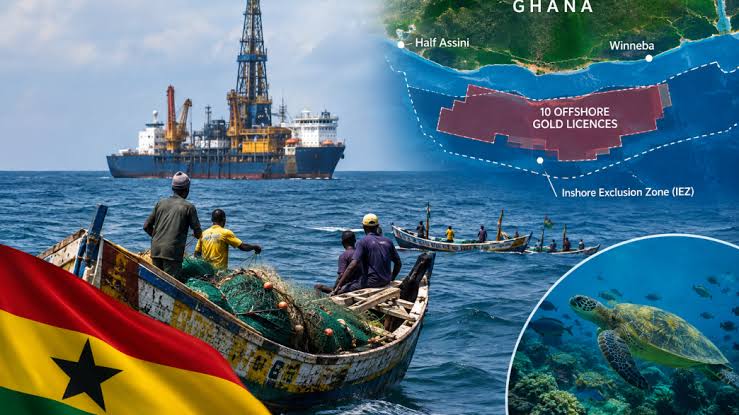
The concerns centre on GoldCoast Resource Corp., which has been granted 10 offshore reconnaissance licences covering approximately 10,000 square kilometres along Ghana’s western continental shelf.
According to the company, its licence area stretches for about 300 kilometres along the coast and extends approximately 33 kilometres offshore. The company says the licences cover an area where gold-bearing river systems meet Ghana’s shallow continental shelf.
The CSOs are particularly concerned about the relationship between the licensed areas and Ghana’s Inshore Exclusion Zone (IEZ).
They cited the Fisheries and Aquaculture Act, 2025 (Act 1146), which defines the IEZ as extending 12 nautical miles from the coastline, equivalent to roughly 22 kilometres.
The organisations said GoldCoast Resource Corp.’s published map appears to show that portions of the licensed area could fall within the IEZ.
However, they acknowledged that the exact extent of any overlap cannot be conclusively determined until the government publishes the official cadastral coordinates and licence instruments.
The CSOs are therefore calling for greater transparency regarding the location, conditions and scope of the licences.
GoldCoast Resource Corp. says it has already completed a major airborne magnetic survey covering its entire 10,000-square-kilometre licence area.
The company reported in August that approximately 50,000 line-kilometres of magnetic data had been collected, while a 500-square-kilometre area around the mouth of the Ankobra River had been identified for more detailed surveying.
The company has said the airborne work is intended to identify geological targets associated with concentrations of heavy minerals that could act as indicators of gold-bearing deposits.
Its stated exploration programme includes further bathymetric and seismic surveys, seaborne mapping, vibro-core drilling and bulk sampling. GoldCoast’s published development timeline also identifies near-shore shallow-water dredging as a potential future phase, subject to the necessary approvals.
The company has also disclosed preliminary coastal sampling results in which visible gold was identified at several locations. It cautions, however, that individual visible gold grains do not establish an average resource grade.
The organisations are also asking the government to clarify the legal basis for proposed seabed activities.
They cited Section 32(3) of the Minerals and Mining Act, 2006 (Act 703), as amended, which they interpret as restricting holders of reconnaissance licences from drilling or excavating.
They also referred to Section 99(6) of the Act and raised questions about the use of floating platforms or other equipment for mining or dredging in Ghana’s natural water bodies.
The CSOs want the government to explain how activities such as vibro-core drilling, bulk seabed sampling, dredging and any eventual extraction would be authorised under Ghana’s existing legal framework.
These are questions raised by the organisations and do not, by themselves, establish that GoldCoast Resource Corp. has breached Ghanaian law.
The CSOs say the concerns must be considered against Ghana’s efforts to rebuild depleted fish stocks and protect coastal livelihoods.
They cited the Marine Fisheries Management Plan 2022–2026, which estimates that the fisheries sector supports approximately 10 per cent of Ghana’s population through fishing, processing, boat ownership, boat building and related activities.
They also referenced the 2022 Canoe Frame Survey, which recorded 110,351 marine artisanal fishers and 12,181 canoes.
According to figures cited by the organisations from the Fisheries Commission’s 2025 Annual Performance Report, artisanal fisheries accounted for 282,658.29 metric tonnes of landings, representing 63.68 per cent of total recorded landings.
The groups argue that these figures demonstrate the importance of carefully assessing any new industrial activity proposed within Ghana’s coastal waters.
The CSOs have raised concerns about the potential effects of seismic and other acoustic surveys, increased vessel traffic, seabed disturbance and sediment plumes.
They say such activities could potentially affect benthic habitats, spawning and nursery grounds and marine mammals.
The groups referenced experiences from other parts of the world, including Alaska and Indonesia, where offshore extractive activities have been associated with environmental changes.
They are calling for Ghana-specific scientific assessments rather than assuming that impacts documented elsewhere would necessarily occur in the same way in Ghana.
GoldCoast Resource Corp. describes its Ghana project as an offshore gold exploration opportunity focused on gold-bearing aggregates on the continental shelf.
The company says it intends to recover potential placer gold through gravity-based separation rather than conventional hard-rock mining methods involving blasting and cyanide processing. It also says the project remains subject to exploration results and regulatory approvals.
The company’s latest published timeline indicates that it was targeting further exploration and environmental permitting during 2026, with additional sampling and potential shallow-water dredging activities outlined for subsequent stages.
The organisations are asking the government to publish:
They are also calling for an independent spatial assessment of the licensed areas and comprehensive environmental, fisheries, socioeconomic and human-rights assessments before intrusive seabed activities are authorised.
The groups further want coastal communities, the Fisheries Commission, relevant government agencies, academics and civil society organisations to participate in the review.
The controversy comes as Ghana seeks to balance natural-resource development with the protection of its fisheries and marine environment.
GoldCoast Resource Corp. says its 10,000-square-kilometre licence package represents a significant offshore exploration opportunity and that it is advancing its geological and geophysical work.
The CSOs, meanwhile, want government to establish clearly where the licences overlap with protected or economically important marine areas and what environmental and legal safeguards would apply before the project advances.
They have asked the government, following its review, to determine whether the existing licences should remain unchanged, be modified to exclude sensitive areas or be cancelled where applicable legal grounds and evidence warrant such action.
For now, the debate centres on how Ghana can develop potential offshore mineral resources while protecting the fisheries, marine ecosystems and coastal communities that already depend on the country’s ocean space.
African360 WhatsApp Channel for more News update: https://whatsapp.com/channel/0029Vb7Oc6nGk1FpdCN0xn44