Physical Address
304 North Cardinal St.
Dorchester Center, MA 02124
Physical Address
304 North Cardinal St.
Dorchester Center, MA 02124

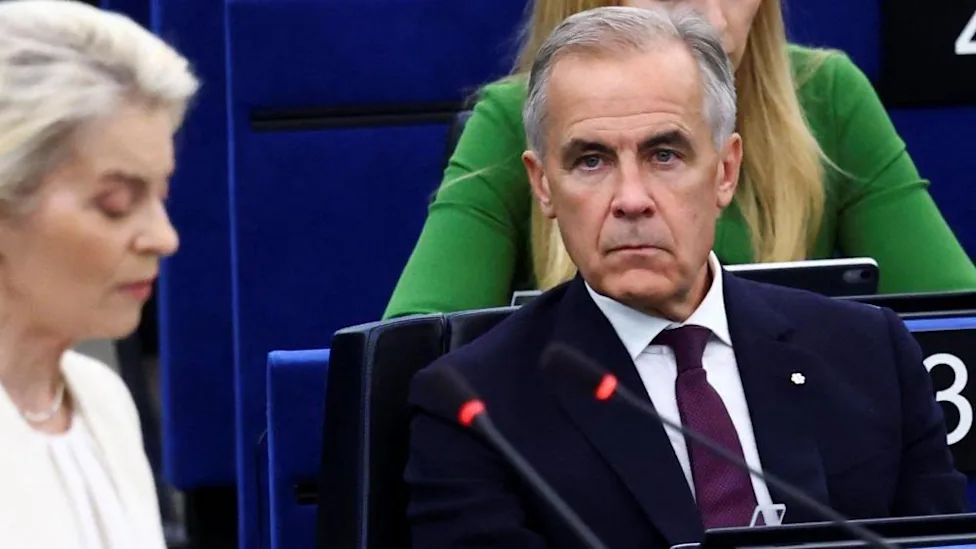
Canada is not preparing to become a full member of the European Union, but an unprecedented proposal from Brussels could create a new form of “associate membership” for Ottawa and significantly deepen cooperation between the two sides.
A remarkable new diplomatic proposal has put Canada and the European Union at the centre of a growing debate over the future of international alliances.
European Commission President Ursula von der Leyen has proposed that Canada become the EU’s first-ever associate member, a status that does not currently exist within the bloc’s established membership structure.
Canadian Prime Minister Mark Carney has welcomed the proposal, telling the European Parliament on Thursday, September 17, that Canada and Europe should strengthen their strategic cooperation across a wide range of areas.
However, Carney has also made clear that Canada is not seeking full EU membership.
The proposed relationship would instead aim to create much closer economic, technological, energy and defence links while allowing Canada to remain outside the 27-member bloc.
That remains one of the biggest unanswered questions.
There is currently no established EU legal status called “associate membership.” European officials and lawmakers are still discussing what such an arrangement could look like and how it could fit within the EU’s treaties.
One possible legal route under discussion is Article 217 of the EU treaties, which allows the EU to establish association agreements with third countries involving reciprocal rights and obligations and special procedures.
However, the precise scope of any Canadian arrangement has yet to be negotiated.
Carney has emphasised that the substance of the relationship will matter more than the eventual name.
He has also said any future agreement would have to respect Canadian sovereignty and go through Canada’s domestic political processes.
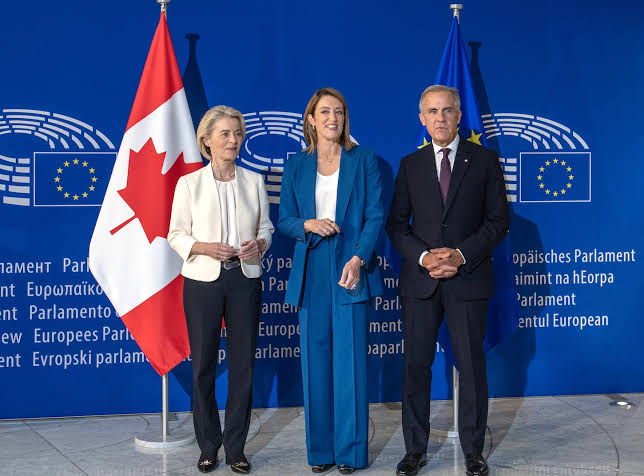
Addressing European lawmakers in Strasbourg, Carney argued that Canada and Europe could become more resilient by working together in strategic sectors.
Among the areas he identified were:
He also proposed closer opportunities for young Canadians and Europeans to live, work and study on either side of the Atlantic.
Carney described the proposed relationship as a way of strengthening the ability of Canada and Europe to protect their economic interests, sovereignty and democratic institutions.
He said the objective was not to establish a new geopolitical bloc against the United States or China.
The proposal has already drawn a sharp response from US President Donald Trump.
Trump dismissed the idea as “laughable” and warned that the United States could impose very heavy tariffs on the European Union or potentially restrict trade if he concluded that the arrangement amounted to a hostile act.
The European Commission has rejected the suggestion that closer EU-Canada cooperation is directed against the United States.
Commission spokesperson Olof Gill said the proposed strengthening of the relationship was intended to build common strength rather than target another country.
The dispute comes amid continuing trade tensions between Washington and Ottawa, as well as wider disagreements between the Trump administration and European governments over tariffs, trade and security.
For Canada, the EU initiative comes as Ottawa seeks to reduce its economic dependence on its southern neighbour.
The United States remains Canada’s dominant economic and security partner, making any major strategic shift difficult.
But the current trade tensions have encouraged Ottawa to explore stronger relationships with Europe and other international partners.
Carney has described the proposed relationship with Europe as part of a broader effort to increase Canada’s strategic resilience rather than abandon existing alliances.
The EU, meanwhile, has also been pursuing stronger economic relationships beyond its traditional partners as it attempts to diversify trade and strengthen its strategic position.
The Canadian proposal could eventually raise a much wider question for countries that want closer relations with the EU without becoming full members.
The European Union already maintains different forms of cooperation with countries outside the bloc, including extensive economic arrangements with nations such as Norway and the United Kingdom.
However, the proposed Canadian status would be different because the EU has never formally created an “associate member” category.
Some European policymakers see the proposal as an opportunity to develop a new framework for strategic partnerships with countries that cannot or do not want to become full EU members.
Others are likely to question how much access, influence and obligation such a status should involve.
The issue could become particularly complicated if countries outside Europe seek similar arrangements.
Despite the enthusiasm surrounding the proposal, Canada is still a long way from becoming an associate member.
The framework would first have to be negotiated, and any eventual agreement would require approval through the EU’s institutional and member-state procedures.
There are also likely to be disagreements over sensitive issues including trade access, agriculture, industrial policy, defence cooperation and the extent of Canada’s participation in EU decision-making.
The lack of an existing legal precedent makes the process particularly uncertain.
The Canada-EU proposal is less about Canada “joining Europe” geographically and more about creating a new model of strategic partnership.
Canada cannot simply become a conventional EU member under the existing framework, and Prime Minister Carney has explicitly indicated that Ottawa is not seeking full membership.
What is emerging instead is an attempt to build deeper cooperation in areas traditionally dominated by national governments: trade, defence, critical minerals, energy, technology, AI and financial infrastructure.
The political significance is also considerable.
If the EU and Canada successfully establish a workable form of associate membership, it could provide Brussels with a new mechanism for working closely with strategically important countries outside the bloc.
For now, however, the proposal remains at the early and exploratory stage. The biggest question is no longer whether Canada and Europe want closer relations — both sides have made that clear — but what an unprecedented associate membership would actually look like in law and practice.