Physical Address
304 North Cardinal St.
Dorchester Center, MA 02124
Physical Address
304 North Cardinal St.
Dorchester Center, MA 02124


Accra, Ghana — September 15, 2026: Ghana is preparing for a major overhaul of how lawyers are regulated and disciplined, with the Deputy Attorney-General and Minister for Justice, Dr Justice Srem-Sai, announcing plans to introduce a new Legal Practitioners’ Standards Board Bill.
The proposed legislation is expected to establish an independent statutory body responsible for setting professional standards and ensuring that lawyers maintain the required levels of competence and ethical conduct throughout their careers.
The announcement was made at the opening of the 2026 Annual Conference of the Ghana Bar Association (GBA) in Ada, held under the theme: “150 Years of Ghana’s Legal Evolution: Transforming the Profession and Driving its Future with Industry.”
The proposed reforms come amid growing concerns about delays in resolving complaints against legal practitioners and questions surrounding the fairness and independence of the current disciplinary system.
According to Dr Srem-Sai, the proposed Standards Board would have responsibility for establishing and maintaining standards of professional conduct and continuing competence for lawyers.
A separate independent disciplinary committee would also be created to handle complaints and disciplinary proceedings.
The separation is intended to ensure that the institutions responsible for setting professional standards are not simultaneously responsible for adjudicating disciplinary complaints.
Dr Srem-Sai said the existing system had struggled with lengthy delays, leaving both complainants and lawyers facing prolonged uncertainty.
“Complaints against lawyers take several years to be resolved,” he said.
He argued that the current arrangement also does not sufficiently separate the investigation of complaints from their adjudication, raising concerns about procedural fairness.
Under the proposed framework, the disciplinary committee would include lawyers, representatives of other professions and lay persons.
Members would have security of tenure, while disciplinary proceedings would be subject to clear and time-bound procedures.
The proposed system would also protect the rights of lawyers facing complaints, including the right to know the allegations against them, the right to be heard and the right to appeal decisions through the courts.
Sanctions would also be expected to be proportionate to the nature and seriousness of professional misconduct.
Dr Srem-Sai was particularly emphatic that the proposed legislation should not be interpreted as an attempt by government to gain political control over lawyers or the disciplinary process.
Instead, he said the objective was to move the process further away from government influence and give the legal profession greater ownership of its own regulatory and disciplinary affairs.
He said extensive consultations would be held with key institutions, including the Ghana Bar Association, General Legal Council, Judicial Council and other stakeholders before the proposed bill is taken to Parliament.
Beyond professional regulation, the Deputy Attorney-General announced three initiatives aimed at improving the welfare and working conditions of lawyers.
They include:
The proposed stipend arrangement is intended to address concerns that young lawyers and pupils can be inadequately supported during their early professional years.
Dr Srem-Sai said the goal should be to ensure that young lawyers are properly trained and mentored rather than exploited as they begin their careers.
Speaking on behalf of the Chief Justice, Justice Anthony Forson Jnr outlined several reforms being undertaken by the Judiciary to modernise Ghana’s justice delivery system.
Among them are the ongoing review of the High Court Civil Procedure Rules and the expansion of the e-Justice programme.
He disclosed that the draft High Court Civil Procedure Rules 2026 was ready to be laid before Parliament when the House resumes from recess.
The reforms are intended to improve efficiency and make the justice system more accessible to the public.
“A justice system cannot remain still while society itself moves forward, and so we must reform,” Justice Forson said.
Artificial intelligence also featured prominently in discussions about the future of the legal profession.
Justice Forson acknowledged the growing ability of AI tools to conduct legal research, analyse documents and produce draft materials.
However, he warned lawyers against becoming so dependent on technology that they lose the human judgement and ethical responsibility at the heart of legal practice.
He argued that the lawyer of the future must combine technological competence with sound professional judgement, ethics and an understanding of the human realities behind legal disputes.
The message was clear: AI may change how lawyers work, but it cannot replace the responsibility lawyers have to clients, courts and society.
While the conference focused heavily on reform, the Ghana Bar Association also used the occasion to raise concerns about the perceived political neutrality of the Judiciary.
GBA President Efua Ghartey expressed disappointment over recent comments by the Chief Justice comparing the performance of a public institution under the current administration with that of a previous government.
She argued that such comments could create the perception that the Judiciary was taking a position in Ghana’s political affairs.
Ghartey also criticised the Judicial Service’s subsequent attempt to defend the Chief Justice’s comments, describing the response as inadequate.
The GBA President reaffirmed the association’s commitment to defending judicial independence under Article 128 of Ghana’s 1992 Constitution.
At the same time, however, she stressed that judicial independence should not be interpreted as giving judicial officers the freedom to engage in partisan political conduct.
She said the Bar would remain vigilant in ensuring that public institutions operate within constitutional boundaries.
Her comments add another important dimension to the conference: the need to modernise the justice system while protecting its independence and public credibility.
The GBA also raised concerns about what it considers excessive bail conditions imposed in some criminal cases.
Ghartey called for bail requirements to be reasonable and proportionate, consistent with the constitutional presumption that an accused person is innocent until proven guilty.
She disclosed that the Bar was considering establishing a Human Rights Watch Committee to monitor compliance with constitutional protections, including Article 14, and provide legal assistance to suspects where necessary.
Such a mechanism could give the legal profession a more active role in monitoring potential violations of the rights of people within the criminal justice system.
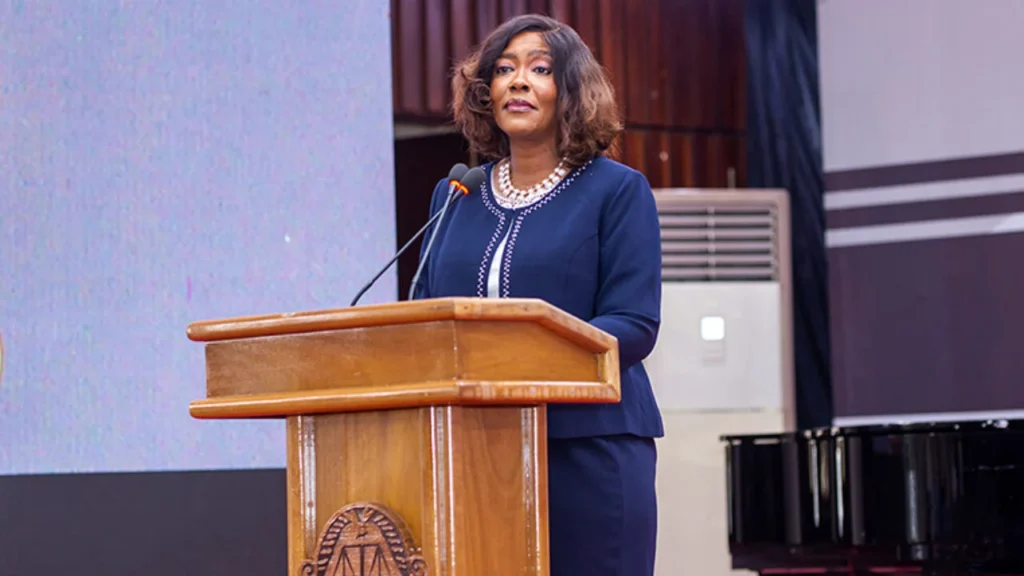
Efua Ghartey, President for Ghana Bar Association
The 2026 GBA conference is also an opportunity to reflect on 150 years of Ghana’s formal legal system.
Ghartey noted that the anniversary of the Supreme Court Ordinance of 1876 provides an opportunity to recognise the contributions of judges, lawyers and other professionals who have shaped Ghana’s justice system.
The profession has expanded dramatically since independence.
According to the GBA President, Ghana had just 11 lawyers in 1957. Today, the profession has grown to more than 12,000 members, with further expansion expected following implementation of the Legal Education Act, 2026.
That growth presents both an opportunity and a challenge: ensuring that a larger legal profession continues to maintain high standards while adapting to technological, economic and social changes.
The proposed Legal Practitioners’ Standards Board could represent one of the most significant changes to Ghana’s legal regulatory system if it eventually becomes law.
The central issue is simple: How do you make lawyers accountable without compromising their independence?
The proposed separation between standard-setting, investigation and disciplinary adjudication could help address concerns about conflicts of interest and lengthy complaint procedures.
But independence must work in both directions.
A regulatory system must be independent from political interference, while lawyers themselves must remain accountable to professional standards, clients and the law.
The concerns raised by the Ghana Bar Association also show why public confidence matters.
Whether the issue is disciplinary complaints, bail conditions, judicial comments or the use of artificial intelligence, the justice system ultimately depends on one essential commodity: trust.
Ghana’s legal profession has come a long way—from just 11 lawyers at independence to more than 12,000 today.
The next 150 years will demand something more than simply having more lawyers.
It will require a legal profession that is independent but accountable, technologically advanced but human, efficient but fair, and powerful enough to defend the law without becoming political itself.
That may be the real test of Ghana’s next chapter in legal evolution.