Physical Address
304 North Cardinal St.
Dorchester Center, MA 02124
Physical Address
304 North Cardinal St.
Dorchester Center, MA 02124
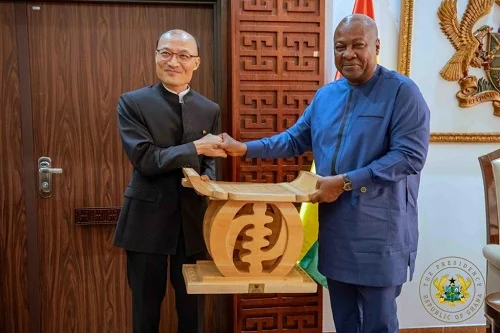
Ghana–China trade surged to a record $14.1 billion in 2025, marking a 19.3% growth. As Ambassador Tong Defa departs, he reflects on deepening ties, zero-tariff benefits, and a future of expanded cooperation.
The economic relationship between Ghana and China has reached a historic milestone. In 2025, bilateral trade between the two nations soared to a record $14.1 billion, representing an impressive 19.3 per cent year-on-year growth. The figure, disclosed by the outgoing Chinese Ambassador to Ghana, Mr Tong Defa, underscores the depth and momentum of a partnership that continues to reshape Ghana’s development landscape.
According to Ambassador Tong, Ghana remains China’s largest trading partner in the region, largely driven by the hundreds of Chinese enterprises operating across the country. These companies have become deeply embedded in Ghana’s economy, contributing to infrastructure development, energy and mining, manufacturing, the digital economy, green agriculture and other strategic sectors.
In practical terms, this means roads, ports, markets, factories, classrooms and energy projects that are directly influencing local industrialisation and socio-economic progress. What was once a diplomatic relationship has evolved into a multi-layered partnership that touches everyday life.
Yet, beyond the numbers lies a story of growing trust, shared ambition and long-term vision.
One of the most significant announcements from the outgoing envoy is Ghana’s inclusion among the first African nations to benefit from China’s zero-tariff treatment on 100 per cent of tariff lines. This policy shift has the potential to redefine Ghana’s export future.
By removing tariff barriers, Ghanaian products—from agricultural goods to manufactured items—will gain unprecedented access to the Chinese market. Ambassador Tong noted that this development aligns seamlessly with Ghana’s 24-Hour Economy policy, opening new pathways for production, processing and export at scale.
In effect, Ghana is being positioned not only as a consumer market, but as a serious exporter into one of the world’s largest economies.
This is more than a trade concession. It is a strategic opportunity.
For Ghanaian entrepreneurs, farmers and manufacturers, it offers the chance to think globally. For policymakers, it reinforces the need to build value chains that can meet international demand. And for young people, it creates prospects for employment in industries tied to export growth.
As Ambassador Tong prepares to conclude his mission in Ghana, his reflections are both personal and symbolic.
“Three decades ago, I first visited Ghana and witnessed the golden vibrancy of the ‘Gold Coast’,” he recalled. “Today, as I conclude my term and prepare to depart, I bid farewell to a nation brimming with vitality and progress.”
Despite the achievements, he acknowledged that some ambitions remain unfinished—among them visiting all regions of Ghana, establishing direct flights between China and Ghana, and introducing Chinese electric vehicle production lines.
These unfinished goals point to where the relationship may head next: deeper connectivity, technological transfer and sustainable innovation.
Over the past year alone, people-to-people exchanges have grown “quietly yet profoundly.” The Chinese Embassy processed a record number of visa applications in 2025, reflecting increased travel for business, education and tourism.
More Ghanaian students are pursuing higher education in China. More Chinese tourists and investors are discovering Ghana. Confucius Institutes continue to promote Chinese language and culture on Ghanaian campuses, while Chinese medical teams provide healthcare services that strengthen bonds at the grassroots level.
This human dimension is often overlooked, yet it is the foundation of enduring diplomacy.
Ambassador Tong highlighted China’s consistent support for Ghana’s Pan-African tradition and its pursuit of a modernisation path suited to national conditions. Both countries, he said, remain aligned in their support for multilateralism, global governance reforms and the promotion of fairness in international relations.
His tenure coincided with several symbolic moments.
On the day of President Mahama’s inauguration, Ghana’s leader met the Special Envoy of President Xi Jinping. During Chinese New Year celebrations, President Mahama attended the Lantern Festival Gala hosted by the Chinese community. Vice President Jane Naana Opoku-Agyemang joined events marking the 76th Anniversary of the People’s Republic of China and the 65th Anniversary of China–Ghana diplomatic relations.
These moments reflect a relationship that is not merely transactional, but increasingly cultural and diplomatic in depth.
Ambassador Tong also witnessed and participated in major development milestones, including:
He attended forums such as the Africa Prosperity Dialogues, the African Political Parties Summit and the Ghana–China Climate Summit, each reflecting the widening scope of cooperation.
Quoting an ancient Chinese poem—“True friendship knows no distance, as close neighbours share hearts across the miles”—Ambassador Tong captured the emotional undertone of his farewell.
“As I depart, my heart is filled with both nostalgia and gratitude,” he said, recalling visits to Independence Square, the Kwame Nkrumah Mausoleum and Cape Coast Castle.
“Wherever the future may take me, Ghana—this land of dynamism and hope, and its warm and remarkable people—will remain a cherished and enduring memory of my diplomatic career.”
The record $14.1 billion trade figure is more than a headline. It is a symbol of a relationship entering a new era—one defined not just by commerce, but by connectivity, shared development goals and people-to-people bonds.
As Ghana looks to industrialise, expand exports and position itself within global value chains, the China partnership will remain central. The challenge now is to ensure that this growth translates into broad-based prosperity, skills development and sustainable progress.
The numbers tell a powerful story. What Ghana does with the opportunity will define the next chapter.
Join African360 WhatsApp Channel for more News update: https://whatsapp.com/channel/0029Vb7Oc6nGk1FpdCN0xn44