Physical Address
304 North Cardinal St.
Dorchester Center, MA 02124
Physical Address
304 North Cardinal St.
Dorchester Center, MA 02124

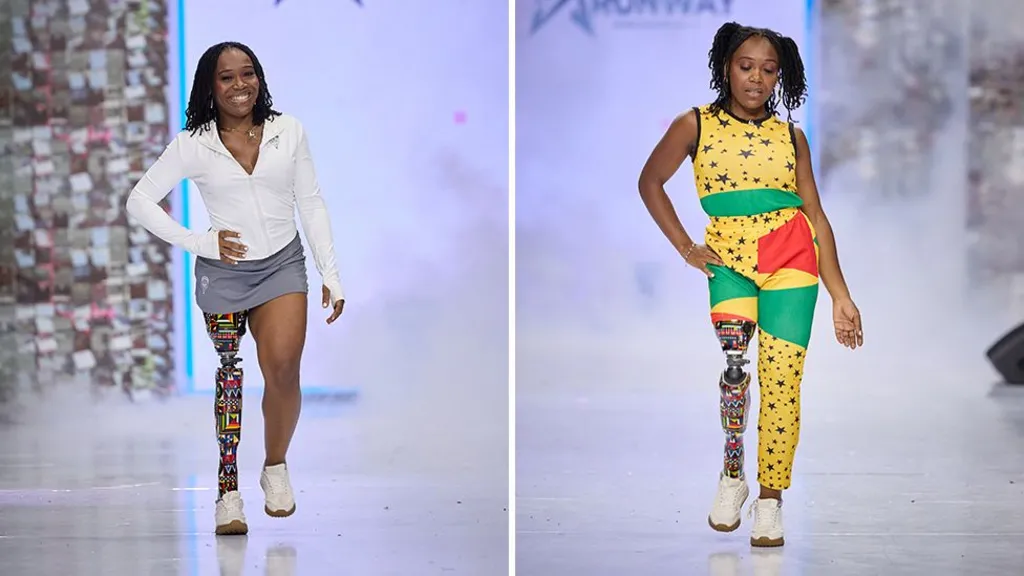
From childhood cancer survivor to runway trailblazer, Abena Christine Jon’el is changing how Ghana sees disability, beauty, and belonging—one powerful step at a time.
It was impossible to ignore Abena Christine Jon’el as she stepped onto the runway at one of Ghana’s biggest fashion showcases. Draped in bold African fabric, her prosthetic leg wrapped in vibrant kente, the 33-year-old model and writer did more than model clothing—she delivered a statement.
In that moment, under bright stage lights and in front of a captivated audience, Abena was not just walking for fashion. She was walking for visibility. For dignity. For a future where disability is no longer hidden or pitied, but seen, celebrated, and respected.
Her appearance at Rhythms on the Runway, one of Africa’s most prestigious fashion events, instantly became one of the night’s defining moments. It was not just because she stood out visually. It was because she represented something Ghana had rarely placed at the centre of its cultural stage: a disabled woman, proud, confident, and unapologetically present.
For Abena, this was not a publicity moment. It was the continuation of a lifelong mission.
Abena’s story began with a decision no parent should have to make. At just two years old, she was diagnosed with rhabdomyosarcoma, a rare and aggressive form of soft-tissue cancer. A tumour had grown on her right calf. Doctors gave her mother two options: radiation, which could leave her confined to a wheelchair, or amputation.
Her mother chose amputation.
Today, Abena speaks of that choice with clarity and gratitude.
“It was the best decision she could have made,” she says without hesitation.
Growing up in Chicago, Abena’s childhood was shaped by hospitals, rehabilitation, and learning how to move through the world in a body that had already endured more than most adults ever would. Movement became a form of survival—and later, self-expression.
But Abena was never the polite, silent version of disability often portrayed in inspirational posters.
“I was loud. I was a little Black girl running around on one leg. I didn’t let anyone push me around,” she says. “I struggled in school. I wasn’t that perfect, sweet disabled child people imagine.”
Her disability did not soften her. It sharpened her.
That fire would later become her strength.
Long before she ever set foot in Ghana, Abena felt a pull toward Africa. In the United States, she immersed herself in African history—particularly West Africa before colonialism. The more she read, the more she felt connected to something she could not yet explain.
Everything changed in 2021 during her first visit to Ghana.
Standing at Assin Manso, the slave river site where enslaved Africans were prepared for the journey to the coast, she experienced what she describes as a moment that “rearranged my entire understanding of myself.”
History met belonging. Memory met identity.
Returning to the US left her broken.
“It felt like I had found a missing part of myself,” she says. “Leaving felt like being torn away from where my soul belonged.”
Three months later, she packed her life into suitcases and moved permanently to Accra.
Ghana, she says, embraced her.
“I am Ghanaian by ancestry and by adoption.”
She now lives with a Ghanaian mother who introduces her as her own daughter. She has been claimed in the way only Ghana can—with warmth, humour, and family.
Her prosthetic leg, wrapped in kente, is a declaration of that bond.
“It always has been, and always will be, kente,” she says. “It represents my love for this country—its heritage, its pride.”
Living in Ghana gave Abena a new purpose.
In the US, she had worked as a poet, writer, and public speaker, sharing her story to inspire others. But in Ghana, she saw a different challenge: disabled people were largely invisible.
“In the States, progress is slow and imperfect, but disabled people are being invited into more spaces,” she explains. “In Ghana, we are still at the beginning. Not because people lack compassion, but because we lack representation.”
Without visibility, stigma thrives.
“People don’t see us in powerful or joyful positions. They only see us in struggle.”
Abena’s mission is simple but radical: change what people see.
Not through pity. Through presence.
“Disability is not a limitation,” she says. “Having a disability is not what makes you disabled. Lack of support and lack of accessibility—that is what disables you.”
Her runway appearance was a deliberate act.
She approached the organisers herself.
“I knew it would be monumental,” she says. “If I wanted inclusivity, I had to be willing to take the first step.”
When she walked, the room changed.
“This is what true inclusion looks like,” said Dentaa Amoateng.
“Her walk was not just a performance—it was a powerful affirmation,” added Culture Minister Abla Dzifa Gomashie.
That night, disabled people were not spectators. They were centre stage.
Abena’s journey is not a story of survival. It is a story of reclamation.
She reclaimed her body.
She reclaimed her identity.
She reclaimed her belonging.
And now, she is helping Ghana reclaim its understanding of inclusion.
Whether on a runway, behind a microphone, or mentoring young amputees, she refuses to dim her light.
“Ghana is my home,” she says.
And with every step she takes, she is helping that home become a place where everyone belongs.
Join African360 WhatsApp Channel for more News update: https://whatsapp.com/channel/0029Vb7Oc6nGk1FpdCN0xn44