Physical Address
304 North Cardinal St.
Dorchester Center, MA 02124
Physical Address
304 North Cardinal St.
Dorchester Center, MA 02124
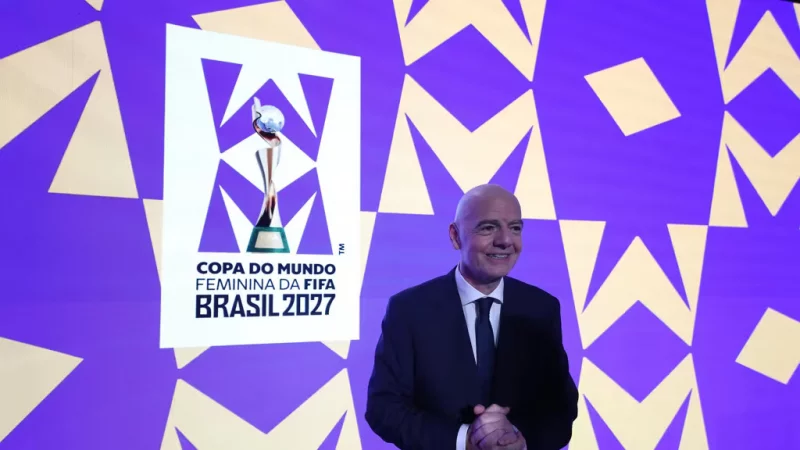
FIFA has revealed the official emblem and identity for the 2027 Women’s World Cup in Brazil, blending culture, football, and ambition in a historic first for South America.
FIFA has officially lifted the curtain on the identity of the 2027 Women’s World Cup, and with it, the world has been given a first taste of what promises to be one of the most culturally rich and emotionally charged tournaments in the history of the women’s game.
For the first time, the Women’s World Cup will be hosted in South America, with Brazil welcoming the world to a celebration of football, culture, and progress. The unveiling ceremony—attended by global icons of women’s football and international media—marked more than a branding moment. It was a declaration that women’s football is entering a new era, one defined by scale, ambition, and global resonance.
At the heart of the reveal is an emblem that speaks in symbols. The logo integrates the letters W and M into the iconic World Cup trophy. The W stands for Women and World, while the M reflects the Portuguese words Mundo (World) and Mulheres (Women). It is a clever, culturally rooted design that connects global identity with local language.
FIFA says the emblem captures both the spirit of women’s football and the vibrant soul of Brazil—a country where football is not merely a sport but a way of life.
FIFA President Gianni Infantino described the launch as a defining milestone, not just for Brazil, but for the global women’s game.
“Football is part of Brazil’s DNA. You can feel the enthusiasm generated by welcoming the whole world and organizing a historic event,” he said.
“You can also feel something stronger, as this country is fully committed to making this event a pivotal moment for women’s football. The official identity reflects the vision we share with our hosts: a joyous, memorable, and deeply Brazilian Women’s World Cup.”
Infantino’s words underscore what many observers already believe: Brazil 2027 is not just another edition of the tournament—it is a statement of intent. It signals FIFA’s determination to place women’s football on equal footing with the men’s game in terms of spectacle, scale, and cultural impact.
What sets this launch apart is FIFA’s holistic approach. The identity of the 2027 Women’s World Cup extends beyond visuals. It includes an official soundtrack, inspired by Brazilian rhythms and samba percussion, designed to echo through stadiums and broadcasts around the world.
This fusion of sound and sport reflects Brazil’s unique cultural energy—where music, movement, and football blend seamlessly. The tournament’s new slogan, “Go Epic,” reinforces this ambition. It is a call to players, fans, and hosts alike to embrace a tournament that is bold, emotional, and unforgettable.
The goal is clear: to create a World Cup that celebrates not only competition, but culture.
Organizers aim to showcase the excellence of women’s football alongside Brazil’s festive spirit—its colour, rhythm, and warmth. In doing so, they hope to offer a tournament that resonates far beyond the pitch.
Brazil is a natural host for a football spectacle, but its role in women’s football carries special significance.
For decades, the global narrative of football has been shaped by men’s tournaments held in Europe, North America, and parts of Asia. Bringing the Women’s World Cup to South America represents both recognition and opportunity. It acknowledges the continent’s growing influence in the women’s game and opens new pathways for development.
Brazil’s football heritage is legendary. From Pelé to Marta, the country has produced icons who have shaped the sport across generations. Hosting the Women’s World Cup offers a chance to spotlight the next wave of talent and inspire millions of girls across Latin America.
It also reflects the global growth of the women’s game. Attendance records are being broken, broadcast reach is expanding, and investment is rising. The Women’s World Cup is no longer a side event—it is a central pillar of the global football calendar.
Beyond entertainment, Brazil 2027 carries a deeper mission: to accelerate equality, visibility, and opportunity for women in sport.
Every element of the identity—from the emblem to the soundtrack—has been crafted to inspire. FIFA wants the tournament to speak to young girls in favelas, villages, and cities across the world, telling them that football belongs to them too.
It is about representation. It is about possibility. It is about changing perceptions.
By embedding Brazilian culture into the heart of the tournament, FIFA is also redefining what a Women’s World Cup can look and feel like. This is not a replica of men’s events. It is its own celebration, with its own voice and rhythm.
With the emblem unveiled and the tone set, attention now turns to the road ahead. Brazil will prepare to welcome teams and fans from every corner of the globe, transforming stadiums into stages of drama and joy.
The promise is immense:
From the streets of Rio to the plains of the Amazon, the Women’s World Cup will touch every part of the country—and every part of the global game.
Brazil 2027 is shaping up to be more than a tournament. It is becoming a movement.
A celebration of women.
A celebration of football.
A celebration of a world finally ready to let the women’s game go epic.
Join African360 WhatsApp Channel for more News update: https://whatsapp.com/channel/0029Vb7Oc6nGk1FpdCN0xn44