Physical Address
304 North Cardinal St.
Dorchester Center, MA 02124
Physical Address
304 North Cardinal St.
Dorchester Center, MA 02124

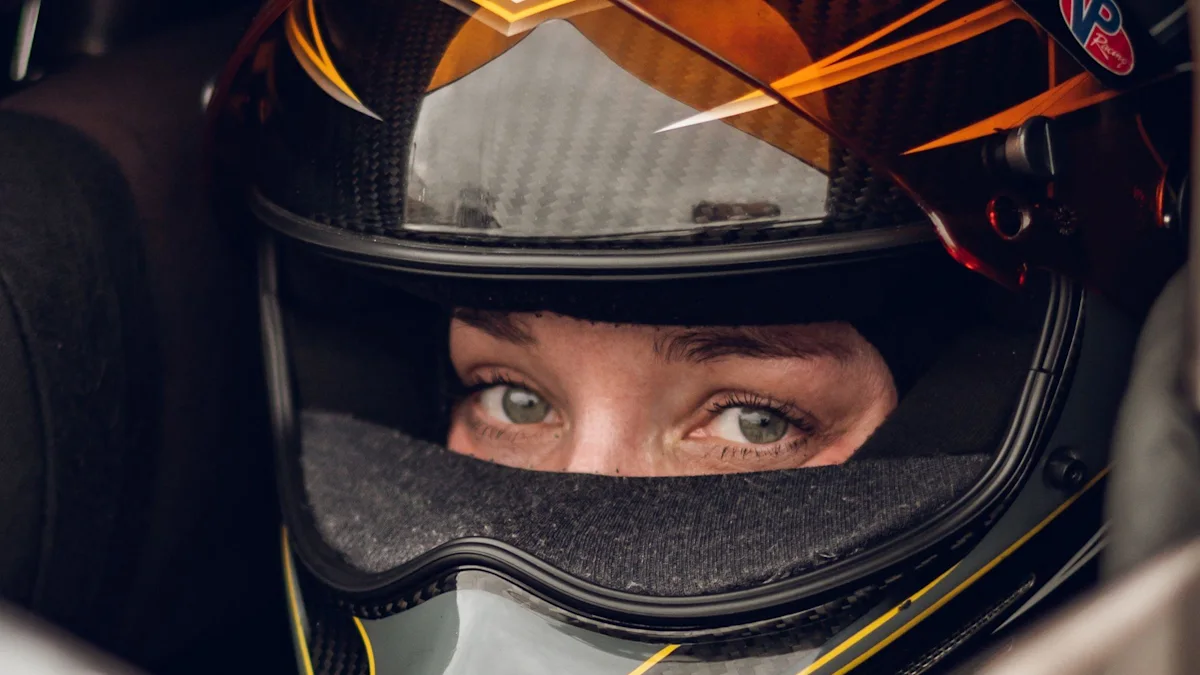
At more than 300mph, Top Fuel drag racing is one of the most physically demanding and dangerous forms of motorsport. Yet it has become an unlikely place where women are not only competing with men but regularly beating them to major titles.
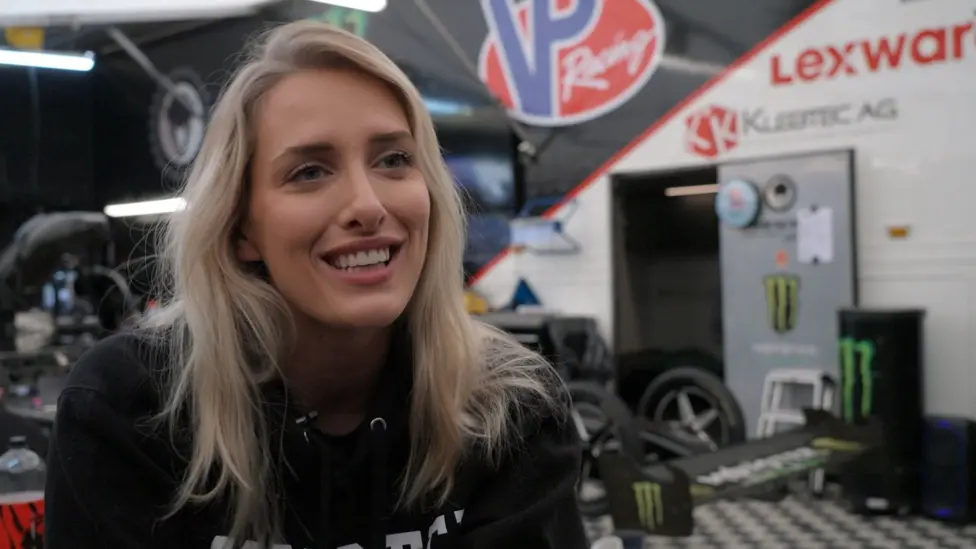
For Swedish driver Susanne Callin, the experience is difficult to describe.
“It’s like being shot out of a cannon,” is the closest comparison she can find.
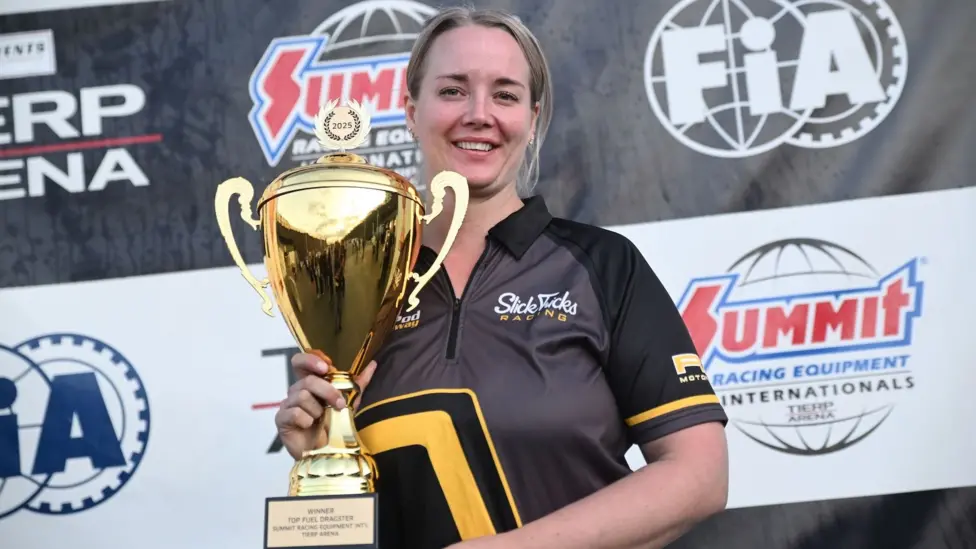
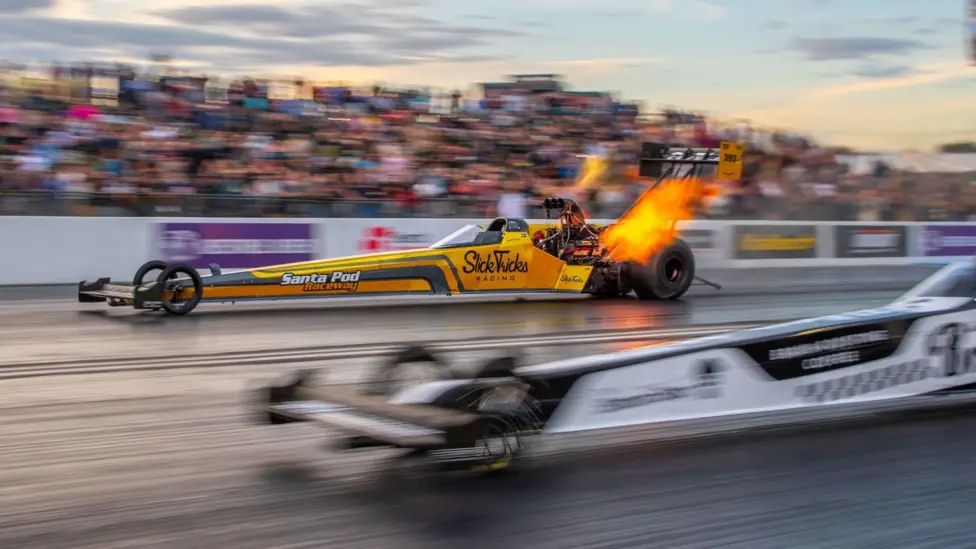
Callin, 43, is a two-time European Top Fuel champion. She secured her second consecutive title in September at Santa Pod Raceway in Northamptonshire, continuing a remarkable run of female success in the championship.
Women have now won seven of the past nine European Top Fuel titles, while female drivers represented about 20% of competitors in this year’s US and European Top Fuel seasons, according to campaign group More Than Equal.
The figures stand out in a sport where women make up only about 10% of participants across motorsport and around 4% of elite drivers.
Top Fuel is the most extreme category of drag racing.
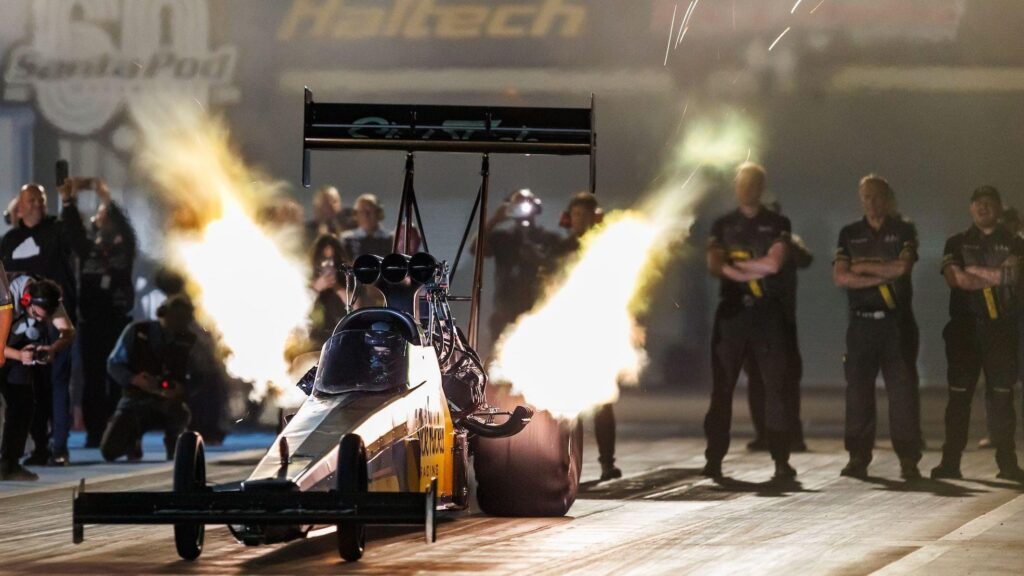
Cars race along a straight 1,000-foot (305-metre) track, accelerating from a standing start to more than 300mph in roughly four seconds.
The force is immediate.
Drivers can reach 100mph within the first second, while another surge of force comes when the clutch fully engages.
At the finish, parachutes deploy from the back of the cars because conventional brakes alone cannot bring them to a stop quickly enough.
“The abrupt halt is like someone kicking you in the chest,” Callin says. “You lose your breath.”
The fastest official Top Fuel speed has exceeded 346mph, significantly faster than the top speeds reached during a Formula 1 Grand Prix.
Speed alone does not make a successful Top Fuel driver.
Drivers must react almost instinctively while making constant tiny adjustments to keep the car straight.
“It has to be instant reactions with everything,” Callin says. “By the time you’ve thought about it, it’s too late.”
The physical demands are equally intense.
Drivers endure enormous forces during acceleration and braking, while operating machines powered by highly specialised nitromethane-fuelled engines.
The risks are real. Top Fuel has experienced fatal accidents, including crashes in 2004 and 2008 that prompted further safety changes and helped lead to shorter race distances.
Drivers now use fire-resistant equipment and heavily protected cockpits, while strict technical regulations are designed to reduce risks.
Callin herself has survived two major crashes, suffering a concussion and a bruised collarbone but no lasting injuries.
What makes drag racing unusual is not simply that women participate.
They are winning.
Fran Longstaff, chief innovation officer at More Than Equal, says research into gender equality in drag racing did not identify physical or biological factors as the main explanation.
Instead, she points to the sport’s culture and structure.
There is a strong grassroots pathway, junior programmes, open pits and a family-oriented environment. Most importantly, women have been winning major drag-racing competitions for generations.
That history has created a steady stream of female role models.
One of the most important was Shirley Muldowney, widely known as the “First Lady of Drag Racing”.
Muldowney became the first woman to obtain a Top Fuel licence and won the NHRA championship in 1977.
She went on to win two more titles in 1980 and 1982, becoming the first driver to claim three NHRA championships.
Her career was not without resistance. She faced hostility from some competitors and fans while fighting for the opportunity to compete at the highest level.
Today, her perseverance is regarded as a major part of drag racing’s history.
Top Fuel has also produced several examples of women returning to elite competition after raising children.
Callin stepped away from racing for more than a decade to raise her daughter and stepdaughters.
When she returned to competition at 35, her career began to flourish.
Finnish driver Anita Mäkelä, a four-time European champion, has followed a similar path. Three of her titles came after a six-year break focused on raising her children and running her family’s chicken farm.
For Callin, racing remains a family affair.
Her father continues to work with her team, while her husband, Keith Bartlett, runs Santa Pod Raceway. Their youngest daughter, Jacqueline, is now racing in adult classes after progressing through junior drag racing.
Despite the fierce competition, the culture around drag racing can be remarkably collaborative.
Callin’s rival and friend, Swiss driver Jndia Erbacher, once helped her with spare parts after her car was damaged.
“We hate each other at the starting line, but we love each other at the finish line,” Erbacher jokes.
Both drivers acknowledge the danger but say respect for the machinery and the risks is essential.
Erbacher initially faced opposition from her own father, who did not want her to race. She eventually told him she would do it with or without his support.
He later became her team manager.
Cost also plays a role.
Reaching Formula 1 can require millions of pounds in funding and sponsorship, creating a significant financial barrier for young drivers.
Elite drag racing is also expensive, but the sport has more accessible entry points, including track days where people can compete using ordinary cars.
That broader grassroots structure gives aspiring drivers more opportunities to develop before reaching the professional level.
In the United States, Brittany Force has also become one of drag racing’s most successful female drivers, winning NHRA championships in 2017 and 2022.
Her achievements sit alongside those of generations of women who have demonstrated that Top Fuel is not exclusively a man’s sport.
More Than Equal says women have won seven of the last nine European Top Fuel championships, while female participation at the elite level remains significantly higher in drag racing than across motorsport generally.
The contrast with Formula 1 is stark. It has been five decades since a woman competed in an F1 Grand Prix.
There is no single explanation.
Top Fuel is an intensely physical sport, but success depends heavily on reaction time, precision, preparation and technical understanding.
More Than Equal’s research points instead towards opportunity, culture and visibility.
Women have had access to the sport’s grassroots structure for decades. They have competed alongside men, built careers, raised families, returned to competition and, crucially, won major championships.
That success has made female drivers less of an exception and more a familiar part of the sport.
For Callin, however, the appeal remains much simpler.
The fear never completely disappears. Neither does the adrenaline.
But once the lights go green, there is no time for hesitation.
“You really have to be one with the car,” she says.
At more than 300mph, that connection can last only a few seconds.
But for women in Top Fuel drag racing, those few seconds have been enough to rewrite what success in motorsport can look like.
Follow the African360 Sports channel on WhatsApp: https://whatsapp.com/channel/0029VbDrVn8HrDZe4uoLW42r