Physical Address
304 North Cardinal St.
Dorchester Center, MA 02124
Physical Address
304 North Cardinal St.
Dorchester Center, MA 02124

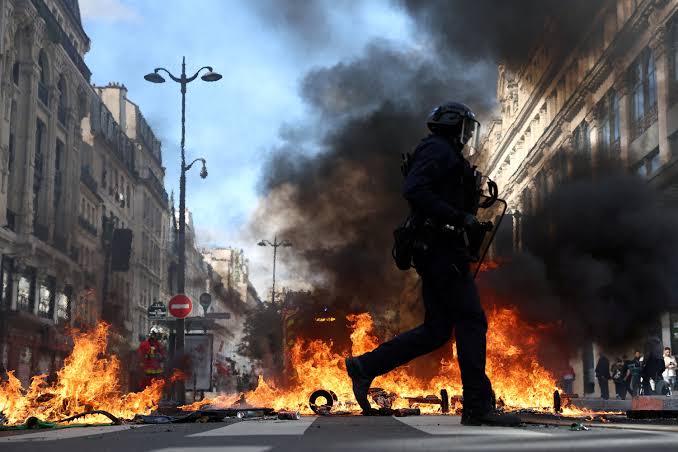
France is facing mounting political pressure after violent riots erupted alongside nationwide protests over the cost of living and public services, raising questions about political accountability, public trust and the future of French democracy.
France’s latest wave of unrest has exposed deep divisions in the country, with peaceful demonstrators demanding better public services while groups of rioters engaged in looting, vandalism and violent confrontations with police.
The violence on October 17, 2026, followed weeks of student-led demonstrations over education conditions and the rising cost of living. What began as a movement driven by social grievances escalated into widespread disorder across Paris and several other French cities.
According to Le Monde, between 550,000 and 800,000 people took part in demonstrations nationwide, depending on whether the figures provided by authorities or organisers are used. The newspaper reported that large peaceful marches took place alongside smaller groups determined to confront the police.
The scenes of smashed shop windows, burning vehicles and damaged public buildings have shocked residents and intensified the political debate over who was responsible for the violence.
One of the biggest questions facing French authorities is whether the disorder was centrally organised or driven by different groups acting independently.
Prime Minister Sébastien Lecornu and Interior Minister Laurent Nuñez have blamed radical-left and ultra-left groups for exploiting the demonstrations. Authorities have also raised concerns about the role of organised groups and the use of social media to coordinate movements during the unrest.
However, the presence of radical activists does not establish that they organised every incident. Reporting from the protests suggests that some groups deliberately confronted police, while other people took advantage of the disorder to steal from shops.
The extent of coordination, the involvement of particular political organisations and the reasons for the security failures remain matters for investigation.
Jean-Luc Mélenchon, leader of the left-wing La France Insoumise (LFI) movement, has rejected accusations directed at his political camp. Mélenchon and other critics have instead questioned the government’s handling of the protests and the police response.
A clear distinction must therefore be made between peaceful students exercising their right to protest, individuals involved in criminal acts and political organisations accused of encouraging violence.
The unrest has also intensified competition among France’s political leaders ahead of the 2027 presidential election.
Marine Le Pen and her National Rally party have long promoted a law-and-order agenda alongside tougher immigration policies. Images of widespread destruction and confrontations with police provide an opportunity for the party to reinforce its argument that the government has failed to maintain public order.
Le Pen has criticised the government’s handling of the crisis and blamed political opponents for contributing to the disorder. Meanwhile, Mélenchon has challenged the government’s conduct and questioned its responsibility for the escalation.
These competing narratives illustrate how a public security crisis can quickly become a political contest over credibility, leadership and the country’s future direction.
Nevertheless, political advantage should not be confused with proof of responsibility. Evidence is needed before claims that any political party deliberately orchestrated the violence can be accepted as fact.

The riots have raised serious questions about whether French authorities were adequately prepared for the scale and intensity of the demonstrations.
The protests had been publicised in advance, yet police faced multiple flashpoints across major cities. The government has promised to hold those responsible for violence and theft accountable, while further security measures have been considered to prevent renewed disorder.
The response also presents a difficult challenge for the authorities. They must protect residents and businesses, restore public order and investigate criminal offences without treating peaceful demonstrators as responsible for the actions of violent individuals.
Heavy-handed policing can deepen public distrust, while a failure to respond effectively to violence can leave communities feeling abandoned. Balancing public safety with the right to peaceful assembly will remain central to the government’s response.
Beneath the immediate crisis lies a broader problem: growing frustration with the political system and whether elected leaders are responding to people’s everyday concerns.
Students and other demonstrators have raised issues including education, living costs, public services and economic insecurity. For many citizens, the protests reflect concerns that their grievances are not receiving sufficient attention.
Research by the Pew Research Center published in June 2026 found that 69% of adults surveyed in France were dissatisfied with the way democracy was working in their country. The survey also recorded dissatisfaction levels of 68% in Spain and 62% in Italy, indicating that discontent extends beyond France.
These findings do not mean that all dissatisfied citizens support street protests or violence. They do, however, point to a challenge for democratic governments: public confidence depends partly on whether people believe institutions can respond to their concerns.
Social media has also changed how protests develop and how images of violence spread. Online platforms can help citizens organise demonstrations and share information, but they can also amplify confrontations and make isolated acts of destruction appear representative of an entire movement.
For ordinary residents and business owners, the immediate consequences are tangible: damaged property, disrupted services, fears about safety and uncertainty over whether further violence will occur.
For peaceful demonstrators, there is another risk. When images of looting and street battles dominate coverage, the social and economic concerns that brought people onto the streets may receive less attention.
That concern was reflected in the words of one Paris resident quoted in the original reporting: “This is not the face of France!” Her message captured the frustration of those who believe that violent scenes should not define an entire country or its population.
France now faces two connected tasks: bringing those responsible for violence to justice and addressing the legitimate grievances that have fuelled weeks of demonstrations.
The coming months will test the government’s ability to restore public confidence while resisting the temptation to reduce a complex crisis to partisan blame.
Ultimately, the central question is not simply who benefits politically from the riots. It is whether France’s leaders can protect the public, uphold democratic freedoms and respond meaningfully to citizens who feel that the political system is no longer listening.
African360 WhatsApp Channel for more News update: https://whatsapp.com/channel/0029Vb7Oc6nGk1FpdCN0xn44