Physical Address
304 North Cardinal St.
Dorchester Center, MA 02124
Physical Address
304 North Cardinal St.
Dorchester Center, MA 02124

By African360 News
Tanzania has announced a major natural gas discovery estimated at 223 billion cubic feet in the Mnazi Bay area of southern Tanzania, marking its first reported new gas discovery in more than a decade.
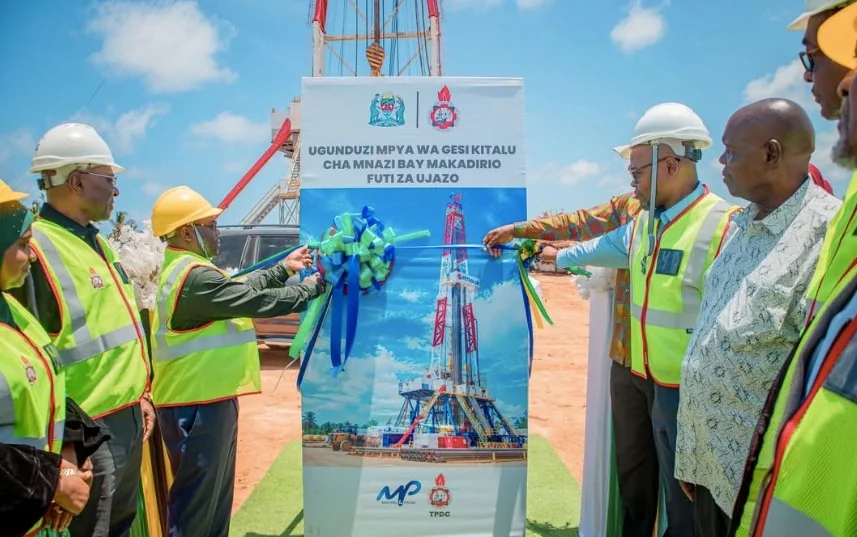
Energy Minister Juma Zuberi Homera announced the find on October 27, 2026, at the Kasa-1X ST2 exploration well in the Mtwara Region. The well was drilled through a partnership between the state-owned Tanzania Petroleum Development Corporation (TPDC) and French energy company Maurel & Prom.
Homera described the discovery as an important development for Tanzania’s energy sector, particularly as electricity consumption and industrial activity continue to grow.
“The discovery is important in ensuring the country has reliable, clean and safe energy at affordable costs,” he said.
The government expects the discovery to strengthen domestic gas supplies and support electricity generation, industrial production and the expanding use of natural gas as a vehicle fuel.
The Kasa-1X ST2 well is expected to begin production as early as November 2026, according to the project’s operator and government announcements.
Homera said the well could produce approximately 30 million cubic feet of gas per day for at least 10 years. Maurel & Prom has separately indicated a potential gross production rate of up to 50 million cubic feet per day. These are different estimates, and the final production rate will depend on the well’s performance and development arrangements.
Two other wells drilled as part of the same campaign, MB-5 and MS-2, have already contributed to increased output at Mnazi Bay.
The additional production is expected to help meet demand from power plants and industrial users, while potentially reducing reliance on imported energy products whose prices can be affected by international market conditions.

Natural gas is central to Tanzania’s electricity system, accounting for nearly 80% of electricity generation according to government statistics for 2024.
Gas from Mnazi Bay supplies power plants in Mtwara and Dar es Salaam. The country also operates the Songo Songo gas field and associated processing and transportation infrastructure.
Tanzania has been promoting compressed natural gas (CNG) as an alternative fuel for vehicles, particularly in Dar es Salaam. Some motorists have converted their vehicles to dual-fuel systems to take advantage of locally available gas, which can be cheaper than petrol.
Additional domestic production could help support these uses, although the extent to which consumers benefit will depend on distribution infrastructure, production costs and pricing arrangements.
Tanzania’s natural gas exploration dates back several decades. Its first discovery was made on Songo Songo Island in 1974, followed by another at Mnazi Bay in 1982. Commercialisation began in 2004, helping establish gas as an important source of domestic energy.
The country’s wider gas resource base is estimated at approximately 57.54 trillion cubic feet, according to Tanzanian authorities.
However, the latest discovery should be treated as an estimate of gas volumes rather than a confirmed figure for commercially recoverable reserves. Maurel & Prom reported an estimate of approximately 200 billion cubic feet gross in its technical update, but did not publicly classify the amount as proved reserves or another specific resource category. The difference between the operator’s estimate and the government’s 223 billion cubic feet figure has not been fully explained publicly.
Further assessment will be needed to establish how much gas can ultimately be recovered commercially.
The discovery comes as Tanzania seeks to expand its energy sector and attract additional investment in natural gas exploration and development.
Homera said TPDC was in discussions with four investors interested in developing small-scale liquefied natural gas projects, three of which are expected to be located in Mtwara.
Such projects could expand the domestic use of gas, support industrial development and create employment opportunities.
The new discovery also highlights the importance of existing infrastructure in southern Tanzania, which could make it easier to develop the resource than a discovery requiring an entirely new processing and transportation network.
While the find is modest compared with Tanzania’s much larger national gas resource base, its location within the producing Mnazi Bay area could help it contribute to domestic supply sooner.
The key test now will be whether the estimated volumes can be developed commercially and delivered reliably to households, power generators and businesses.
For Tanzania, the discovery offers renewed momentum for gas exploration and the opportunity to strengthen domestic energy security as the economy continues to grow.
African360 WhatsApp Channel for more News update: https://whatsapp.com/channel/0029Vb7Oc6nGk1FpdCN0xn44