Physical Address
304 North Cardinal St.
Dorchester Center, MA 02124
Physical Address
304 North Cardinal St.
Dorchester Center, MA 02124
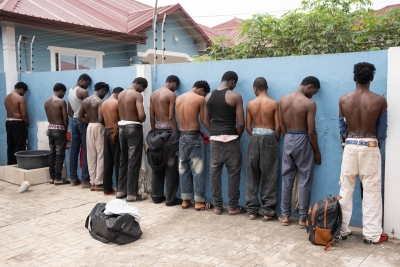
Ghanaian security agencies have arrested 19 people and seized 303 electronic devices in Sasaabi, near Accra, as part of an international crackdown on online scam networks and suspected human trafficking operations.
The United States Department of Justice (DOJ) disclosed the figures on Tuesday, October 13, 2026, as it announced the results of Joint Disruption Week, a coordinated enforcement effort targeting transnational criminal networks operating in West Africa.
The operation resulted in 28 arrests across Ghana and Nigeria, the removal of more than 3.7 million scam-linked social media accounts, pages and groups, and the identification of more than 100 suspected human trafficking victims.
According to the US Justice Department, authorities identified 117 Nigerian nationals believed to be victims of human trafficking during the Sasaabi operation. At the time of the department’s announcement, they were awaiting repatriation to Nigeria.
Investigators also identified 89 victims of online scams who reportedly suffered combined losses estimated at approximately US$8.3 million.
The Ghana operation was led by the Cyber Security Authority (CSA), the Criminal Investigation Department of the Ghana Police Service and the National Security Service, with support from the United Kingdom’s National Crime Agency (NCA), the Federal Bureau of Investigation (FBI) and Nigeria’s Economic and Financial Crimes Commission (EFCC).
The latest enforcement action followed operations at six locations in Ghana during the final week of September. Those activities resulted in numerous arrests, the identification of 34 suspected trafficking victims and the seizure of 129 electronic devices, according to the DOJ.
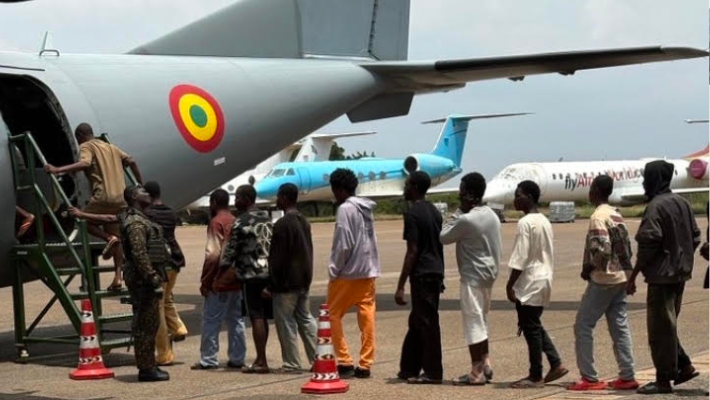
Separately, Ghana’s Minister for Communication, Digital Technology and Innovations, Samuel Nartey George, announced on October 13 that 120 Nigerian nationals had been repatriated to Nigeria following an intelligence-led operation targeting suspected cybercrime activities.
The minister thanked the Ghana Air Force and the Ministry of Defence for facilitating their return. He said the individuals had been trafficked to Ghana and forced to work in cybercrime operations.
According to Mr George, the operation resulted in the seizure of 136 mobile phones, 130 laptops, internet connectivity devices and four motor vehicles. One of the vehicles was reportedly stolen from Canada.
Investigators also recovered jewellery, 10 Nigerian passports and other digital equipment. The minister added that eight other individuals were being processed for prosecution, although he did not publicly specify the alleged offences.
The DOJ’s figure of 117 people awaiting repatriation and the minister’s announcement that 120 Nigerians had been returned are reported at different stages of the enforcement and repatriation process. The available announcements do not fully explain the difference between the figures.
Joint Disruption Week involved law enforcement agencies from several countries, including Ghana, Nigeria, the United Kingdom, the United States, Australia, Canada, India and New Zealand, alongside INTERPOL and private-sector technology companies.
The DOJ said participating companies—including Meta, Adobe, Binance, Coinbase, Google, Microsoft, OpenAI, Starlink and TRM Labs—took voluntary action on their platforms and networks to disrupt suspected scam operations.
Their efforts resulted in the removal of more than 3.7 million accounts, pages and groups targeting people in the United States, the United Kingdom and other locations. Private-sector partners also shared information on more than 30 suspected scam centres with law enforcement, helping investigators pursue arrests, identify trafficking victims and trace cryptocurrency-related assets.
The department added that private-sector partners identified more than US$11 million in funds that could potentially be frozen. The figure represents funds identified for possible freezing, rather than money confirmed to have been recovered.
FBI Director Kash Patel said the operation had led to arrests, the seizure of hundreds of electronic devices and the identification of potentially freezable funds. Nick Sharp, the NCA’s Deputy Director of Fraud, also stressed the importance of international cooperation in pursuing fraud networks that operate across national borders.
The DOJ described scam centres in West Africa as organised operations that recruit and train individuals to conduct online fraud using social engineering and multiple digital platforms.
The schemes targeted during the operation included impersonation of law enforcement officers, digital arrest and extortion scams, cryptocurrency investment fraud—often known as “pig butchering”—and other online scams targeting victims internationally.
The department cited FBI Internet Crime Complaint Center figures showing the scale of reported investment fraud. Reported losses from investment scams with a cryptocurrency connection exceeded US$7.2 billion in 2025, representing a 24 per cent increase, according to the figures included in its announcement.
The crackdown highlights the overlap between cybercrime and human trafficking, as some people found at suspected scam centres may themselves have been trafficked and forced to participate in criminal activity.
Ghanaian authorities say enforcement efforts are continuing, with eight individuals being processed for prosecution, according to the communications minister. The operation also reflects growing cooperation among Ghanaian agencies and international partners to disrupt online fraud networks, identify victims and pursue suspected offenders.
African360 WhatsApp Channel for more News update: https://whatsapp.com/channel/0029Vb7Oc6nGk1FpdCN0xn44