Physical Address
304 North Cardinal St.
Dorchester Center, MA 02124
Physical Address
304 North Cardinal St.
Dorchester Center, MA 02124

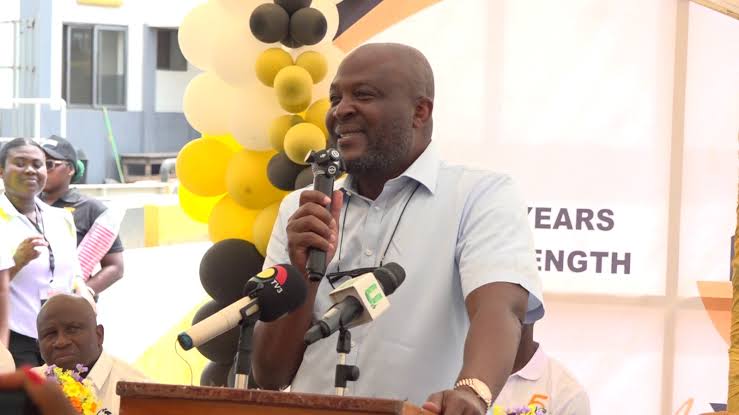
ACCRA — Ghanaian businessman Ibrahim Mahama has called for greater confidence in local entrepreneurs and deliberate state support to help more Ghanaian-owned businesses grow into major, sustainable enterprises.
The Founder, Sole Shareholder and Group Chief Executive Officer of DZATA Holdings made the call as Dzata Cement marked its fifth anniversary, reflecting on the challenges of building what the company describes as Ghana’s only wholly Ghanaian-owned cement manufacturing operation.
For Mahama, the achievement goes beyond producing cement. He said it was about demonstrating that Ghanaian entrepreneurs can conceive, finance, build and manage large-scale industrial businesses in sectors critical to the country’s development.
“We can build it ourselves,” he said.
He explained that one of his motivations for establishing Dzata Cement was to challenge the perception that Ghanaians must depend on foreign companies to build major businesses.
Mahama said entrepreneurship should not be measured only by the success achieved during an entrepreneur’s lifetime.
He argued that a successful business should have the structures, people and leadership needed to survive its founder.
That belief has influenced his decision to gradually step away from the day-to-day management of Dzata Cement and give younger executives greater responsibility.
“We won’t live forever. So sometimes we should give the children the opportunity to be able to take that risk of managing,” he said.
He described succession as an important part of his broader business philosophy, in which younger members of the next generation are introduced to the business, trained and eventually prepared to take on leadership responsibilities.
That approach is already reflected at Dzata Cement, where his daughter, Nafisa Mahama, serves as Managing Director.
Mahama traced the origins of Dzata Cement to his earlier experience as a cement transporter and mining contractor.
Following his trucks to the Ghacem facility in Takoradi gave him an opportunity to observe the cement manufacturing process more closely.
Rather than viewing the industry as one reserved for large foreign companies, he said the experience convinced him that he could build a cement plant himself.
“I looked at the structure and said, look, I could build one,” he recalled.
He subsequently travelled to Germany, engaged equipment manufacturers and began assembling the financing needed to establish the factory.
The project encountered significant financial and operational difficulties during construction and equipment installation. Mahama said support from his younger brother and others helped the project reach completion.
He also credited distributors who stood by the company during its difficult early period, particularly when the business faced challenges raising funds to clear imported clinker.
Their support, he said, helped the company bring its first cement onto the market and begin building its customer base.
Five years after operations began, Dzata Cement’s manufacturing facility near the Tema Port represents an investment of more than $100 million, according to the company.
The plant occupies about 10 acres and uses technology supplied by German equipment developer Haver & Boecker.
Its bagging lines can process an average of 120 bags per minute, while the company says its current operations have a capacity of approximately 80,000 bags per day, equivalent to about two million tonnes annually.
The company expects to produce its 30 millionth bag of cement within days, marking another milestone in its five-year journey.
For Mahama, those figures represent more than industrial output. They are evidence, he argues, that Ghanaian-owned businesses can operate successfully in capital-intensive sectors.

Mahama also urged business and political leaders to give younger Ghanaians meaningful responsibilities rather than simply preparing them to follow established paths.
He said the country needs a new generation of “doers” capable of taking over from today’s business leaders.
His own approach, he explained, involves allowing younger people to learn by participating directly in the management of businesses.
“We start running together and then as our children grow, we employ them into the business, we teach them, and then we go into retirement,” he said.
Dzata Cement Managing Director Nafisa Mahama said the company’s fifth anniversary was an opportunity to recognise the customers, distributors and employees who had supported the business.
She said customers who continued to choose Dzata Cement during difficult periods had played an important role in establishing the brand in Ghana’s construction industry.
She also praised distributors for remaining committed to the company and helping expand its market presence.
Employees, she said, remained central to the company’s future.
Nafisa pledged that staff welfare would continue to be prioritised while the company invests in developing the human capacity needed to sustain its operations over the long term.
She also acknowledged the contributions of local and international suppliers, GCB Bank, government institutions and the Chamber of Cement Producers.
As it enters its next phase, Dzata Cement plans to expand its product range and strengthen its manufacturing and distribution capabilities.
Plant Director Abderrahim Ouahab said the company was considering additional cement grades and exploring the introduction of a 25kg bag alongside its existing 50kg packaging.
Other priorities include strengthening the company’s laboratory, increasing Health, Safety and Environment training and pursuing ISO 9001, ISO 14001 and ISO 45001 certifications.
The company also plans to improve spare-parts and inventory management while introducing artificial intelligence and other digital technologies into selected operations.
One of its major planned capital projects is a 300-tonne-per-hour Multi Big Bag Receiver, which is expected to improve jumbo-bag handling, cement transfer, screening, dust collection and recycling.
Dzata Cement also plans to expand storage capacity to 40,000 tonnes and develop an automated packing facility capable of handling about 6,000 tonnes per day.
Management’s long-term target is to produce at least three million tonnes of cement annually.
Finance Director Godfred Barnes said Dzata Cement’s progress had been built on hard work, sacrifice and resilience.
He said the company had had to navigate supply-chain disruptions, rising freight costs, inflation, exchange-rate volatility and other operational pressures.
Barnes said the finance function was not simply about accounting for money but about protecting the company’s long-term vision and ensuring that every department contributed to efficiency and financial sustainability.
He reaffirmed Dzata Cement’s ambition to become Ghana’s number-one cement manufacturing company by 2030.
The company says its first five years established the foundation, while the next five will focus on disciplined investment, stronger distribution, reliable production, customer service and tighter cost management.
Beyond cement manufacturing, Dzata plans eventually to expand into ready-mixed concrete and other cement-related products and services.
For Mahama, however, the bigger legacy may lie beyond the factory itself: proving that Ghanaian entrepreneurs can build industrial companies capable of surviving challenges, creating jobs and preparing the next generation to take the business forward.
African360 WhatsApp Channel for more News update: https://whatsapp.com/channel/0029Vb7Oc6nGk1FpdCN0xn44