Physical Address
304 North Cardinal St.
Dorchester Center, MA 02124
Physical Address
304 North Cardinal St.
Dorchester Center, MA 02124
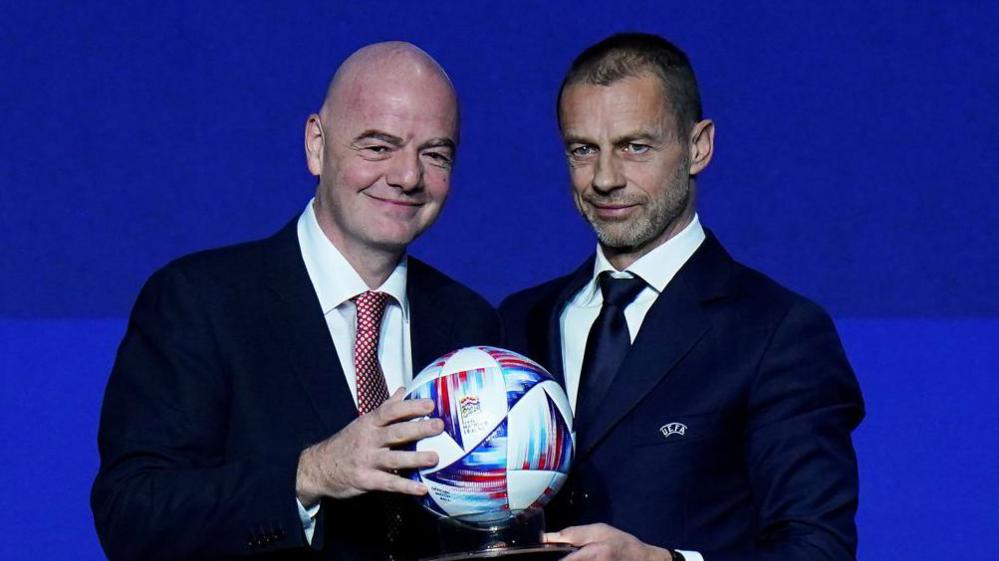
BERLIN — European football leaders are facing a race against time to find a candidate capable of challenging Gianni Infantino for the FIFA presidency as tensions between UEFA and world football’s governing body continue to grow.
UEFA’s 55 member associations are due to meet in Berlin on Thursday for a previously scheduled summit that is now taking place against the backdrop of an increasingly open challenge to Infantino’s leadership.
The meeting is expected to focus on FIFA governance, transparency and UEFA’s strategy for the presidential election, which is scheduled for March 18 in Rabat, Morocco.
The immediate challenge for UEFA and its allies is to agree on at least one credible candidate before the November 18 deadline for entering the race.
Relations between UEFA and Infantino have deteriorated following FIFA’s controversial proposal to sell investment stakes linked to the World Cup.
The plan, announced in July, was withdrawn within days after facing strong opposition, particularly from European football officials.
UEFA has since intensified its scrutiny of FIFA’s leadership and is considering legal action in Switzerland over what it says could involve financial mismanagement linked to the World Cup proposal.
The European body has also sought authorisation from US courts to obtain documents that could potentially be used in a criminal complaint.
UEFA general-secretary Theodore Theodoridis said last month that relations with FIFA had reached a point where European football needed to seek changes.
“Somewhere along the way things went too far with FIFA, and we’re looking to put things back where they belong,” he said.
The comments reflect broader concerns within UEFA about what some European officials view as the growing concentration of power around Infantino.
UEFA represents 55 of FIFA’s 211 member associations, giving Europe more than a quarter of the votes in the presidential election.
However, Europe is not completely united behind the effort to challenge Infantino.
The Associated Press has estimated that Infantino already has around 90 votes pledged, although that figure was calculated before a confirmed challenger entered the race.
Some UEFA members are also understood to support the incumbent, including Azerbaijan and Latvia.
Infantino travelled to Prague on Wednesday, where he met football and government officials as he continues his international engagement ahead of the election.
One of the biggest questions facing UEFA is who could actually emerge as its candidate.
UEFA president Aleksander Čeferin has repeatedly rejected suggestions that he intends to run for FIFA president, although he said recently that there were “many, many” possible candidates.
Other senior football figures have also been linked with the contest.
FIFA vice-president and CONCACAF president Victor Montagliani is expected to concentrate on his own re-election campaign at CONCACAF in February.
Asian Football Confederation president Sheikh Salman bin Ebrahim Al Khalifa, who previously challenged Infantino in the 2016 FIFA election, is another potential figure discussed in European football circles.
However, neither currently appears certain to enter the FIFA race.
Paris Saint-Germain president Nasser Al-Khelaifi has also frequently been mentioned as a possible candidate because of his close relationship with Čeferin.
But Al-Khelaifi ruled himself out last week while speaking at a meeting of the European Football Clubs group, which he chairs.
The Berlin summit is therefore expected to be about more than simply finding a name for the ballot.
UEFA wants any potential challenger to commit to reforms aimed at making FIFA more transparent and strengthening oversight of the organisation.
The European body and its allies have previously criticised Infantino over the proposed World Cup investment structure, accusing FIFA of failing to properly consult key stakeholders.
In August, Čeferin joined FIFA vice-presidents from Asia and North America in accusing Infantino of deception and a breach of trust over the proposal. Those are political and institutional allegations from FIFA officials and allies rather than established findings of wrongdoing.
The dispute has nevertheless created one of the most serious challenges to Infantino’s leadership since he became FIFA president in 2016.
Infantino remains in a strong electoral position unless UEFA can build a broad international coalition behind a challenger.
Europe’s 55 votes alone would not be enough to defeat an incumbent who has already secured substantial support outside the continent.
That means UEFA will need to persuade football associations in other confederations to support its preferred candidate and its proposed governance reforms.
The November 18 nomination deadline leaves European officials with limited time to settle on a candidate, build a campaign and convince other FIFA members that a change in leadership is necessary.
For now, the Berlin meeting represents an important test of whether Europe can turn its growing frustration with FIFA into a coordinated electoral challenge.
The question is no longer simply whether UEFA wants change at FIFA.
It is whether Europe can agree on who should lead that change — and convince the rest of world football to follow.
Follow the African360 Sports channel on WhatsApp: https://whatsapp.com/channel/0029VbDrVn8HrDZe4uoLW42r