Physical Address
304 North Cardinal St.
Dorchester Center, MA 02124
Physical Address
304 North Cardinal St.
Dorchester Center, MA 02124

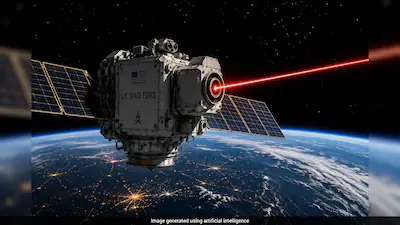
Washington, D.C. — September 2026: The United States has publicly acknowledged for the first time that it has deployed an offensive space weapon in Earth’s orbit, marking a significant development in the growing military competition beyond the planet.
US Secretary of the Air Force Troy Meink confirmed the existence of an “on orbit” weapon during the Air, Space and Cyber Conference on Monday, saying the capability was necessary to protect American forces against hostile action.
However, US officials have revealed almost nothing about the system itself.
Meink did not disclose the weapon’s specific capabilities, its location or when it was placed into orbit.
He said the United States must remain prepared for what he described as “evolving threats” in space.
The announcement has immediately raised questions about what type of weapon the United States has placed in orbit.
The US Space Force has confirmed that its broader space-control mission includes capabilities designed to disrupt, degrade and, when necessary, destroy an adversary’s space assets.
Those capabilities can be used for both offensive and defensive purposes, depending on military command decisions.
But officials have stopped short of saying whether the newly acknowledged system is designed for electronic warfare, satellite disruption or physical destruction.
That secrecy has left experts attempting to determine what the announcement actually means.
Dr Bleddyn Bowen, an expert on military space policy at the Royal United Services Institute (RUSI), said publicly available information was extremely limited.
Speaking to the BBC’s Today programme, Bowen said the system could potentially involve a range of technologies.
One possibility, he suggested, is an electronic warfare or radio-jamming platform capable of interfering with communications.
Such technology would not necessarily destroy a satellite physically but could prevent an adversary from effectively using it.
Another possibility would be a kinetic anti-satellite system capable of physically striking another satellite.
However, Bowen considered that scenario less likely because destroying satellites in orbit can generate large amounts of dangerous space debris.
The US announcement has already triggered a reaction from China.
Beijing warned Washington against expanding military capabilities in space and urged the United States not to push the world towards an arms race beyond Earth.
A Chinese Foreign Ministry spokesman called on the US to stop what China described as preparations for warfare in outer space.
The response reflects growing international concern that military competition between major powers could increasingly move from traditional battlefields into orbit.
Space has become increasingly important to modern military operations.
Satellites provide critical services including communications, navigation, intelligence gathering, surveillance and battlefield coordination.
That means disabling an opponent’s satellites could potentially undermine military operations on Earth without a conventional attack on territory.
The United States has repeatedly warned that both China and Russia are developing counter-space capabilities.
US Space Force assessments say China is developing and operating space and counter-space systems as part of its military modernisation programme.
Washington has also accused Russia of treating space as a potential battlefield and developing capabilities that could threaten satellites.
Russia has denied or declined to publicly address some of the US allegations.
Concerns about space warfare have intensified since Russia’s invasion of Ukraine.
Reports have indicated that Russian satellites may have interfered with or monitored communications involving European satellites.
The United States has also previously said Russia launched a satellite that it believed could potentially attack other spacecraft.
These developments have fuelled fears that future conflicts could involve attempts to disable or destroy the satellites on which modern militaries depend.
The announcement comes as the administration of President Donald Trump places greater emphasis on space-based defence capabilities.
The administration has promoted its proposed “Golden Dome” missile-defence system, which includes space-based capabilities and interceptor technology intended to protect the United States against missile and other airborne threats.
Trump has also previously taken steps to strengthen the role of the US Space Force, including its ability to conduct offensive operations when directed.
The US Space Force was established in 2019 as the first new branch of the US military in more than seven decades.
Its responsibilities include protecting American space assets and ensuring US forces can continue using space-based systems during conflict.
The military use of space exists within a complicated legal framework.
The 1967 Outer Space Treaty prohibits placing nuclear weapons and other weapons of mass destruction in orbit around Earth.
However, the treaty does not impose a blanket ban on all conventional weapons in space.
That distinction has allowed major military powers to develop and test a range of anti-satellite and counter-space capabilities.
The result is a growing grey area in which nations can develop systems designed to interfere with, disable or potentially destroy satellites without necessarily violating the treaty’s prohibition on weapons of mass destruction in orbit.
The US admission represents more than another military technology announcement.
It is a sign that space is increasingly being treated as a genuine domain of warfare.
For decades, satellites were largely viewed as supporting infrastructure for military operations on Earth. Today, they are becoming targets in their own right.
The strategic logic is understandable.
If an enemy depends on satellites for navigation, intelligence and communications, being able to disrupt those systems could provide a major advantage during a conflict.
But there is a dangerous consequence.
A physical attack on satellites can produce debris travelling at extraordinary speeds, potentially threatening other spacecraft—including civilian and commercial satellites that have nothing to do with the conflict.
And unlike traditional military bases, space infrastructure is increasingly shared by governments, businesses and civilians.
The biggest concern, therefore, is not simply that the US has deployed a space weapon.
It is that China, Russia and other powers may respond by accelerating their own programmes.
That could create a cycle in which every major power feels compelled to develop more sophisticated offensive and defensive systems simply because its rivals are doing the same.
For Africa and the wider developing world, this may seem like a distant confrontation between superpowers.
It is not.
Modern African economies increasingly depend on satellites for communications, weather forecasting, navigation, agriculture, banking, disaster management and internet connectivity.
A major conflict in space could therefore have consequences far beyond Washington, Moscow or Beijing.
The race for military dominance in orbit has begun to enter a new and uncertain phase.
And the world still has one crucial question to answer:
How do nations prevent outer space from becoming the next battlefield?