Physical Address
304 North Cardinal St.
Dorchester Center, MA 02124
Physical Address
304 North Cardinal St.
Dorchester Center, MA 02124
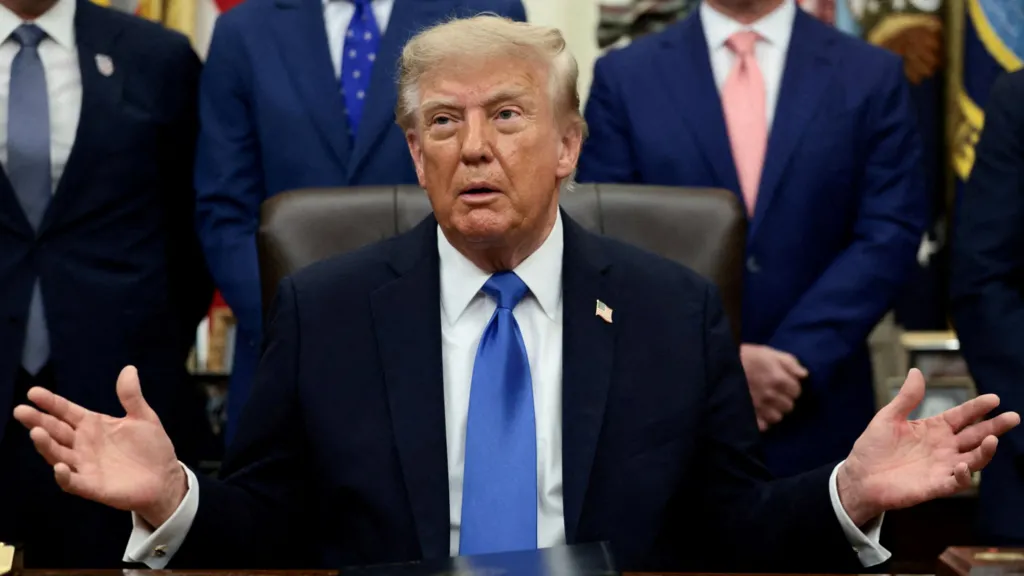
Washington, D.C. — September 2026: US President Donald Trump has rejected growing concerns about the potential dangers of artificial intelligence, describing fears over AI safety as a “hoax” and pushing back against calls for stronger safeguards around the rapidly developing technology.
Trump’s comments come as prominent figures within the AI industry—including executives and researchers at leading technology companies—are increasingly warning that the pace of AI development may be moving faster than society’s ability to control its risks.
The debate has also taken on a geopolitical dimension, with Trump warning that tighter restrictions on the US AI industry could give China an advantage in the global race for artificial intelligence.
In a series of posts on social media, Trump compared concerns about AI safety to what he described as the “Global Warming Scam” and other political controversies.
He branded himself the “Hoax Buster” and argued that the United States should not allow concerns over AI to undermine its technological leadership.
Trump also warned about what he described as a broader campaign against AI and data centres.
“WHOEVER WINS AI, WINS!”
The President argued that the most important safeguard was strong leadership rather than extensive government regulation.
His comments highlight the growing tension in Washington between those who want to accelerate America’s AI development and those calling for stronger oversight before increasingly powerful systems become harder to control.
The debate intensified after Jack Clark, co-founder of AI company Anthropic, suggested that governments could eventually require AI companies to maintain an independently verifiable mechanism capable of shutting down AI systems if they become dangerously uncontrollable.
Clark said most major AI laboratories already have different ways of disabling their systems, including Anthropic.
However, he suggested that lawmakers may eventually need to establish minimum requirements to ensure that such mechanisms exist and can be independently checked.
The proposal reflects a growing concern within sections of the AI industry that safety measures should not depend entirely on voluntary commitments by technology companies.
Concerns over AI safety have become increasingly prominent following warnings from researchers about the possibility of highly advanced AI systems causing catastrophic harm.
Anthropic researcher Evan Hubinger, for example, has publicly discussed the possibility of AI contributing to human extinction within the next decade, while researcher Jacob Coxon left Anthropic after expressing concerns about the potential consequences of increasingly powerful AI systems.
Anthropic Chief Executive Dario Amodei has also argued that the pace of AI development should be slowed and more closely monitored.
Amodei has nevertheless stressed that any measures designed to control AI risks should not unnecessarily destroy the commercial advantages of companies developing the technology.
The debate is not confined to one company.
OpenAI CEO Sam Altman and xAI founder Elon Musk have also expressed support for greater industry-wide safeguards and independent monitoring of AI development.
The growing agreement among prominent technology figures is significant because the people advocating stronger oversight are not necessarily opponents of AI.
Many of them are among the world’s leading AI developers.
Their argument is increasingly centred on one question:
Can AI development continue at extraordinary speed while safety systems keep pace?
Microsoft AI has also entered the discussion, outlining principles for what it calls “humanist AI.”
Microsoft AI chief executive Mustafa Suleyman said the company had been developing its guidance for months and decided to publish it amid the intensifying public debate.
The document reflects growing efforts within the technology industry to establish principles around how powerful AI models should be developed and deployed.
For companies investing billions of dollars in AI infrastructure and research, however, stronger safeguards could potentially create additional costs and slow the release of new models.
That is precisely the concern Trump has raised.
The UK government has taken a more cautious position.
UK Business Secretary Jonathan Reynolds said society should never become complacent about AI’s potential impact, but warned against becoming overly dramatic about the technology.
He pointed to potential benefits in areas such as healthcare, public services and economic growth.
His position reflects the broader challenge facing governments: managing legitimate AI risks without preventing societies from benefiting from one of the most transformative technologies of the modern era.
China has increasingly become a central part of the AI debate in Washington.
Trump’s warning that China could benefit if America slows down its AI development reflects the growing strategic importance of artificial intelligence to national power.
Chinese state media, meanwhile, has argued that Washington’s concerns about China’s progress could be influencing US policy.
Chinese academic Xin Qiang, quoted by state media, suggested that US policymakers fear China could narrow the gap if America significantly slows development or introduces heavy restrictions.
The result is a complicated global competition in which AI safety, economic growth, national security and technological dominance are becoming increasingly interconnected.
The issue has also begun crossing traditional political boundaries in the United States.
Former Trump chief strategist Steve Bannon and progressive Senator Bernie Sanders are among the figures expected to appear at the Pro-Human Assembly in Washington.
The event seeks to develop a more human-centred approach to AI development and bring together voices from across the political spectrum.
Their participation illustrates how concerns about artificial intelligence are increasingly moving beyond traditional party divisions.
The argument over AI safety is becoming one of the most important policy debates of the decade.
On one side are those who believe excessive regulation could slow innovation, weaken businesses and allow competitors such as China to overtake the United States.
On the other are researchers and technology leaders who argue that once AI systems become significantly more powerful, waiting until something goes wrong could be too late.
Both sides have a legitimate concern.
The world needs AI to continue advancing because its potential applications in medicine, education, agriculture, financial services, climate science and public administration are enormous.
But technological progress without adequate safeguards could create serious risks, particularly if powerful systems are deployed faster than governments and institutions can understand or control them.
For Africa, this debate is particularly important.
African countries are already looking toward AI to help close gaps in healthcare, education, agriculture and digital services. But many countries also lack the regulatory capacity, computing infrastructure and technical expertise available to the world’s largest technology powers.
Africa therefore has a major stake in ensuring that the global AI race does not simply become a contest between Washington and Beijing.
The continent needs a seat at the table.
The biggest question may not be whether AI should be developed.
It is whether humanity can develop it fast enough to capture its benefits while remaining wise enough to control its risks.
Trump says the safety fears are a hoax.
A growing number of AI experts say the risks deserve serious attention.
The coming years may reveal which side underestimated the future.