Physical Address
304 North Cardinal St.
Dorchester Center, MA 02124
Physical Address
304 North Cardinal St.
Dorchester Center, MA 02124

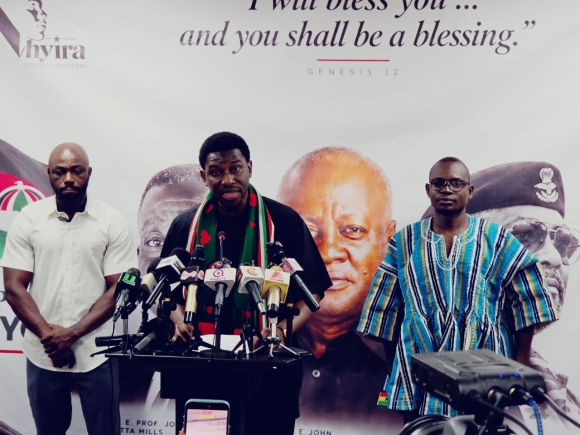
Accra, Ghana — September 14, 2026: A new voice is seeking to reshape the conversation around youth leadership within the National Democratic Congress (NDC), with Mr Odarteifio declaring his intention to lead the party’s youth wing on a platform centred on economic empowerment, opportunity and inclusion.
Speaking at a press conference at the Ghana International Press Centre in Accra on Monday, September 14, 2026, Odarteifio said he was driven by a sense of responsibility to the millions of young Ghanaians who placed their hopes and confidence in President John Dramani Mahama and the NDC.
For him, the next chapter of youth leadership must go beyond political mobilisation and focus on something young people urgently need: access to real economic opportunities.
Odarteifio acknowledged government initiatives such as Adwumawura, the National Apprenticeship Programme and One Million Coders, describing them as important steps towards creating opportunities for young people.
But he argued that government programmes alone are not enough.
According to him, opportunities only become meaningful when young people know about them, can access them and have the support and organisation necessary to take advantage of them.
He therefore called for a new approach to youth leadership—one that does not simply mobilise young people during election periods, but helps connect them with skills, capital, technology, enterprise, agriculture and markets throughout the political cycle.
“I do not want a youth wing that only knows how to mobilise young people for elections. I want one that knows how to mobilise opportunity between elections.”
That message formed one of the strongest themes of his declaration.
Odarteifio said the NDC youth wing should become a vehicle through which young Ghanaians can gain economic independence.
He argued that the party’s relationship with young people should not be limited to asking for their votes. Instead, young people should be able to see tangible improvements in their lives through access to jobs, entrepreneurship, agriculture, training and markets.
He said his ambition would be to help create economic opportunities for one million additional young people before the end of the Mahama administration.
He also spoke about supporting agricultural economic enclaves, providing agricultural equipment, helping local artisans manufacture farming machinery, supporting women processors and young farmers, and strengthening agricultural education in tertiary institutions.
Odarteifio said his position on youth empowerment was informed by practical experience rather than theory.
He pointed to work he says has contributed to opportunities and improved livelihoods for more than 100,000 young people across Ghana.
A major part of his address focused on the barriers young people face when attempting to rise through political and social structures.
Odarteifio questioned whether Ghanaian politics should continue to be influenced by how much money a person has, how famous their name is or how well connected they are.
He argued that a person’s ideas, character, service and ability to deliver should matter more than their financial resources or political connections.
He said young people should not have to become wealthy or politically powerful before they can be heard.
For young NDC activists, including unemployed graduates, struggling entrepreneurs, branch organisers, constituency activists and foot soldiers who feel overlooked, he said the message should be clear: their dreams and contributions should not be dismissed simply because they do not yet have the money or influence to command attention.
Odarteifio identified three values that he said have shaped his life and approach to leadership:
Empathy — understanding another person’s struggle and treating it as a responsibility.
Innovation — developing practical solutions to real problems.
Persistence — continuing to push until meaningful change is achieved.
He recalled becoming involved in community initiatives at a young age, including efforts aimed at supporting vulnerable children and improving a struggling public school.
He said those early experiences later influenced his work in agriculture, enterprise and youth development.
In presenting his political vision, Odarteifio also invoked some of Ghana’s most influential historical figures.
He cited Yaa Asantewaa as an example of courage and leadership, Kwame Nkrumah for his ability to organise and mobilise young people towards independence, and Jerry John Rawlings for rising from the ranks of the Ghana Air Force to become a defining figure in Ghana’s political history.
His message was that leadership does not always begin with wealth, fame or an established political name.
Sometimes, he suggested, it begins with an idea, a cause and people willing to believe in it.
Odarteifio said he wants to see an NDC youth wing that remains active even when there is no election campaign.
Such a youth wing, he argued, should be helping young people access opportunities, build businesses, develop skills, enter agriculture, embrace technology and find markets.
His broader argument is that political power should ultimately translate into economic opportunity for ordinary citizens.
He said a successful youth empowerment agenda could strengthen the relationship between young people and the NDC and help build a generation that sees the party not merely as a political organisation, but as a platform capable of improving livelihoods.
Concluding his declaration, Odarteifio appealed directly to Ghana’s young people.
He told those who feel invisible, forgotten or excluded from opportunities that their names should not determine whether their voices are heard.
He said readiness for leadership should instead be measured by ideas, character, service, impact and the ability to deliver.
He also linked his campaign to the need to address economic inequality and the political culture often described by the phrase “something small for the boys.”
For him, tackling that culture requires creating genuine economic pathways so that young political activists and community organisers do not have to depend on personal wealth or patronage simply to gain recognition.
He described his candidacy as an expression of faith in young Ghanaians and a belief that a relatively young person with a message, experience, limited resources and a committed community can still rise and lead.
“Their dreams are not too big, and their names are not too small.”
That, ultimately, was the heart of his declaration.
Odarteifio’s declaration comes at a time when youth unemployment, rising living costs and limited access to capital remain major concerns for young Ghanaians.
His strongest proposition is therefore not simply that the NDC should have a new youth leader. It is that the meaning of youth leadership itself must change.
For years, political youth structures across Africa have often been heavily focused on mobilisation during elections. But after the votes are counted, many young activists return to the same economic difficulties they faced before the campaign.
That creates an important question for the NDC: Can its youth wing become an institution that connects young people to opportunities even when there is no election to win?
If Odarteifio’s vision is implemented effectively, the youth wing could potentially become a bridge between government programmes and the young people those programmes are designed to serve.
But the real test will not be the strength of the declaration.
It will be delivery.
Young Ghanaians will ultimately want to know how many people gain jobs, how many businesses receive meaningful support, how many young farmers obtain equipment and markets, how many graduates gain useful skills and how many young entrepreneurs move from survival to sustainable businesses.
The political message is powerful.
Now comes the difficult part: turning the message into measurable opportunity.
For a generation that increasingly wants results rather than promises, that is where the real leadership test begins.