Physical Address
304 North Cardinal St.
Dorchester Center, MA 02124
Physical Address
304 North Cardinal St.
Dorchester Center, MA 02124

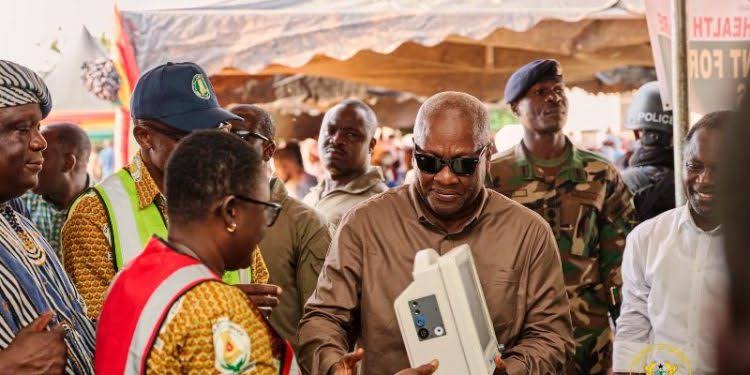
President John Dramani Mahama has pledged to make basic healthcare accessible to Ghanaians regardless of where they live or their ability to pay, as the government expands its Free Primary Healthcare Programme to underserved communities across the country.
The President said the initiative is designed to remove two major barriers that continue to prevent people from seeking medical care: distance and cost.
So far, 135 of the 150 deprived districts targeted under the first phase of the programme have been covered, with the remaining 15 expected to be brought on board by the end of the year.
The government intends to expand the programme to all 261 districts by the end of 2028.
Mahama made the announcement during a community engagement at the Fian Health Centre in the Daffiama-Bussie-Issa District of the Upper West Region.
The programme is designed to bring primary healthcare closer to households rather than expecting people in underserved communities to travel long distances before receiving basic medical attention.
Under the initiative, services at CHPS compounds, health centres and polyclinics will be provided without payment for eligible basic healthcare needs.
These include basic diagnosis and treatment, antenatal and postnatal services, and treatment for common illnesses such as malaria, typhoid and diarrhoea.
One of the notable features is that patients will not need a National Health Insurance card to access the free primary healthcare services under the programme.
Medicines supplied at the primary healthcare level will also be provided free of charge, according to the President.
Mahama said the programme is not only intended to treat illnesses after people become sick.
It is also designed to place greater emphasis on prevention, screening and early detection.
Health professionals will visit households to assess residents and screen them for health conditions, particularly non-communicable diseases such as hypertension and diabetes.
The approach could be particularly important in communities where residents may not routinely visit health facilities because of cost, distance or other barriers.
Instead of waiting for patients to arrive at hospitals, the programme seeks to take basic healthcare directly to them.
The government is also planning to establish health kiosks in communities and busy locations, including lorry stations.
The initiative will be implemented in collaboration with the Ghana Private Road Transport Union (GPRTU).
The kiosks are expected to provide basic outpatient services and be digitally connected to district hospitals.
This would allow health workers to seek remote consultations and facilitate referrals when patients require more advanced medical attention.
The concept could help bridge the gap between communities and larger healthcare facilities, particularly in areas where transportation remains a major obstacle.
The Ghana Health Service has already begun household-level implementation of the programme.
Director-General Prof. Dr Samuel Kaba Akoriyea said more than 54,000 households had been assessed, while 12,016 home visits had been conducted within the first week of implementation.
In the Daffiama-Bussie-Issa District alone, more than 5,749 households had been registered, with health workers conducting over 590 home visits since September 7.
The figures demonstrate the scale of the government’s attempt to move primary healthcare beyond traditional health facilities.
Perhaps the most striking illustration of the problem came from the story of 87-year-old Benjamin Nkuri.
According to the Ghana Health Service, Nkuri had reportedly gone 54 years without visiting a hospital, largely because of financial and distance-related barriers.
His case demonstrates why simply building health facilities may not always be enough.
For some people, the challenge is getting to the facility in the first place.
For others, the cost of consultation, medicines or transportation can discourage them from seeking care until an illness becomes serious.
The Free Primary Healthcare Programme is intended to address those barriers before they become life-threatening.
Health Minister Dr Kwabena Akando described the programme as part of the government’s broader effort to achieve universal health coverage.
“Healthcare must begin from the communities,” he said, explaining that health workers would conduct screenings in homes, churches, mosques and villages.
That approach represents a significant shift towards community-based healthcare.
Rather than concentrating resources primarily around hospitals, the government wants basic services and preventive care to reach people where they live.
The ambition behind Ghana’s Free Primary Healthcare Programme is significant.
Providing basic healthcare without direct payment and taking screening services into homes could make a meaningful difference, particularly in deprived and rural communities.
But the success of the programme will ultimately depend on implementation.
Free healthcare on paper is not enough.
Ghana will need enough trained health workers, medicines, diagnostic equipment, reliable digital systems and functioning referral networks to make the promise meaningful.
The government will also have to ensure that the programme can be financed sustainably as it expands from 150 deprived districts to all 261 districts by 2028.
The decision to include prevention is particularly important.
Hypertension and diabetes can remain undetected for years, especially among people who rarely visit health facilities. Early screening could allow such conditions to be identified before they develop into more serious complications.
The story of Benjamin Nkuri also provides a powerful reminder of what is at stake.
If someone can go more than five decades without visiting a hospital because healthcare is too far away or too expensive, then the country’s healthcare challenge is not simply about hospitals.
It is about access.
And that is precisely where this programme will be judged.
If Ghana can successfully take primary healthcare to the doorstep of underserved communities, the policy could become one of the country’s most important public-health interventions.
The promise is simple: where you live — and what you earn — should no longer determine whether you can receive basic healthcare.