Physical Address
304 North Cardinal St.
Dorchester Center, MA 02124
Physical Address
304 North Cardinal St.
Dorchester Center, MA 02124

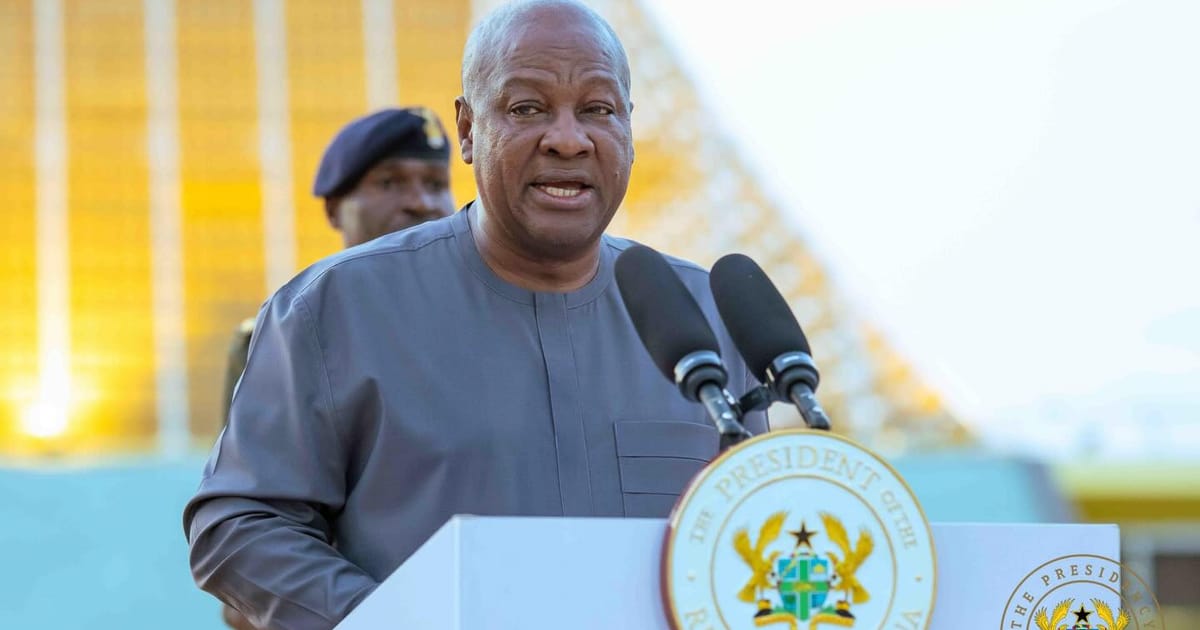
President John Dramani Mahama has reaffirmed his government’s commitment to completely phase out Ghana’s double-track system in senior high schools by the end of 2027.
The President said no senior high school in the country should still be operating the double-track system beyond 2027, promising that students will eventually return to a system where all learners attend school and go on vacation at the same time.
According to Mahama, ending the system will increase the amount of time students spend learning with their teachers and ultimately improve educational outcomes.
He made the commitment during a Citizens’ Engagement in Wa, held at the end of his two-day Resetting Ghana Tour of the Upper West Region.
President Mahama disclosed that the government had secured a $300 million World Bank facility to support efforts to eliminate the double-track system.
The financing is expected to contribute to measures needed to expand and improve infrastructure so that senior high schools can accommodate students under a single academic calendar.
The double-track system was introduced to deal with pressure on infrastructure following the expansion of access to Free Senior High School education.
While the policy allowed more students to enter SHS, it also meant schools had to divide students into different groups and operate separate academic tracks.
Mahama’s latest commitment signals an intention to move beyond that arrangement.
One of the major arguments for ending double-track education is the amount of time students and teachers spend together in the classroom.
Under the current arrangement, different groups of students operate on separate schedules, limiting the number of contact hours available to some learners.
Mahama said removing the system would allow students and teachers to interact more consistently.
The government believes that increased classroom contact could contribute to improved teaching, learning and examination outcomes.
For parents and students, the change would also bring greater predictability to the academic calendar.
The President also addressed some of the financial challenges facing senior high schools.
He argued that the Free SHS programme was initially introduced without a dedicated funding source, leaving schools dependent on annual government budget releases.
According to Mahama, delayed releases contributed to recurring complaints from headteachers over inadequate resources and shortages of food.
He said some schools were forced to work with whatever food supplies were available because deliveries were not always received on time.
The government has since established dedicated funding arrangements for senior high schools and student feeding programmes, he said.
“Today, we have established dedicated funding for senior high schools,” Mahama stated, adding that dedicated financing for student feeding had also helped reduce complaints from school heads.
The President also addressed the public debate surrounding the latest West Africa Senior School Certificate Examination (WASSCE) results.
Rather than engaging in a detailed debate over the statistics, Mahama said the results were available for the public to examine.
He expressed satisfaction that the results reflected what he described as the genuine performance of students.
The President linked this partly to stronger invigilation and a reduction in organised examination malpractice.
He said Ghana must move away from a culture in which students expect leaked examination answers or challenge teachers who attempt to enforce discipline.
“Our children must succeed because they have learned, and our teachers must teach with integrity,” he said.
Ending double-track education will be a major test for the government’s education policy.
The system helped expand access to secondary education, but it also exposed significant infrastructure and financing gaps.
Removing it permanently will therefore require more than a political deadline.
Ghana will need enough classrooms, laboratories, dormitories, dining facilities, sanitation infrastructure, teachers and reliable funding to ensure that schools can accommodate growing enrolment without returning to the pressures that led to double-track education in the first place.
President Mahama’s commitment gives Ghana’s education sector a clear target: by the end of 2027, double-track SHS should be history.
That is an ambitious deadline.
The $300 million World Bank facility could provide important support, but the success of the transition will ultimately depend on how effectively the money is converted into functioning infrastructure and sustainable educational capacity.
There is also a bigger question.
Ending double-track education should not simply mean putting more students into existing schools.
The goal should be to create a system where students receive more classroom time, better learning conditions and stronger academic support.
Parents will therefore judge the policy not by government announcements, but by what they see in schools.
If the 2027 deadline is achieved without compromising quality, it could become one of the most significant developments in Ghana’s secondary education system since the expansion of Free SHS.
But the clock is already ticking.
By the end of 2027, Ghanaian students and parents will expect to see one academic calendar, one school schedule and an education system with the capacity to serve every student properly.