Physical Address
304 North Cardinal St.
Dorchester Center, MA 02124
Physical Address
304 North Cardinal St.
Dorchester Center, MA 02124

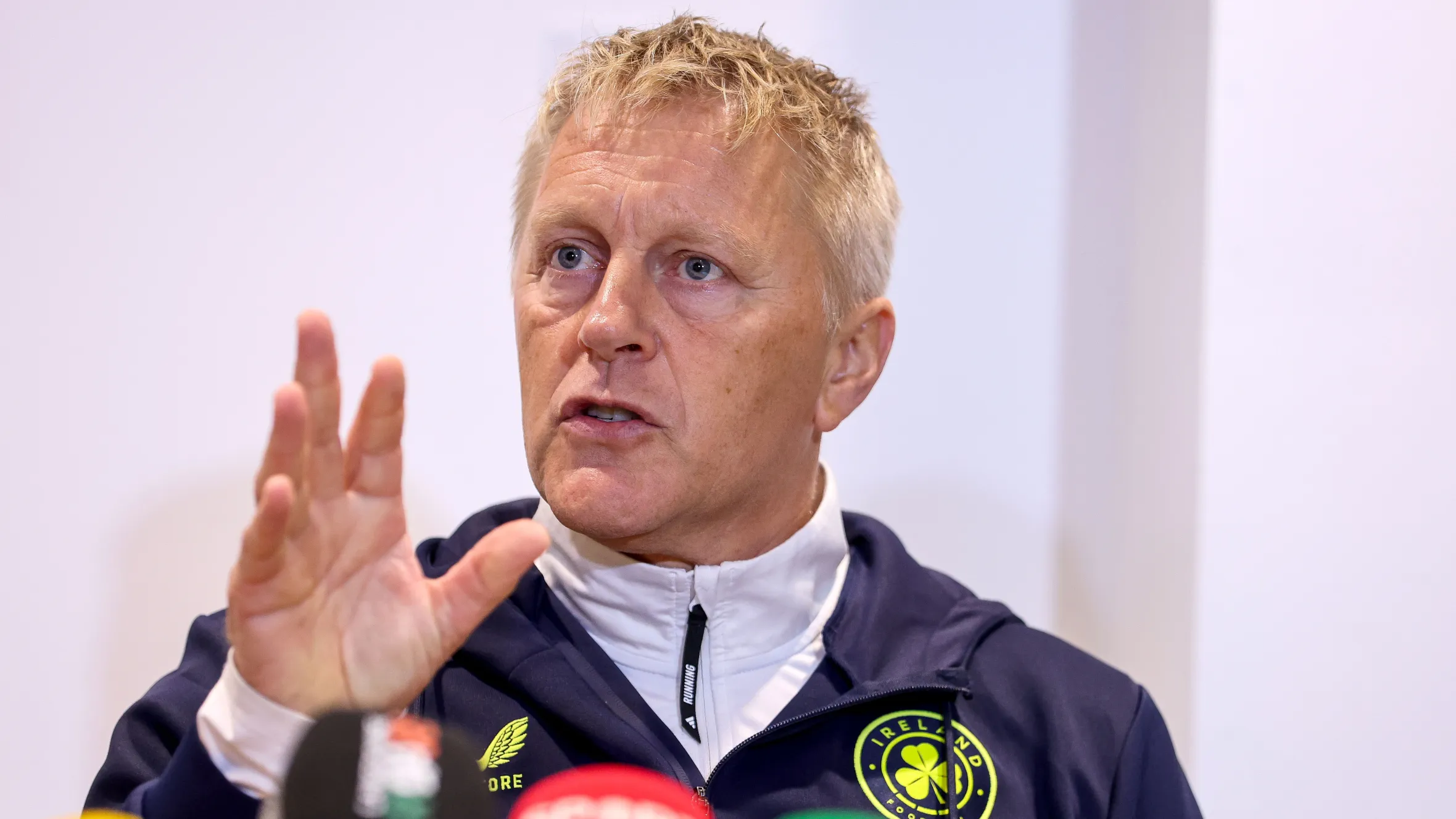
The Israel Football Association has launched a sharp public response to Republic of Ireland manager Heimir Hallgrímsson after he described the country’s upcoming Nations League fixtures against Israel as playing “against genocide.”
Hallgrímsson made the comments last week while discussing the challenge of keeping his players focused on football during a politically sensitive international window.
“We’re not playing with genocide, we’re playing against genocide. We’re playing against Israel, we’re not playing with Israel,” the Ireland manager said.
The Israel FA responded on social media on Monday, accusing Hallgrímsson of “stupidity, ignorance and hypocrisy.” The Football Association of Ireland has declined to comment on the response.
The Israeli federation’s response has added another layer of controversy ahead of the two Nations League meetings.
Reports indicate that the Israel FA is considering whether to make a formal complaint to UEFA over Hallgrímsson’s comments.
The two countries are scheduled to meet in Debrecen, Hungary, on September 27, before playing the return fixture in Bačka Topola, Serbia, on October 4. Both matches are being staged away from the teams’ normal home grounds amid security concerns.
The October fixture is also due to be played behind closed doors, while Irish supporters will not be permitted to attend the September match.
The dispute comes as pressure continues to build in Ireland for the national team to refuse to play the fixtures.
More than 160 Irish sportspeople have signed an open letter calling on the players to boycott the matches.
Among those named as signatories are Olympic athlete Ciara Mageean, former Republic of Ireland footballer Louise Quinn, former Ireland rugby international Tony Ward, and several prominent figures from Gaelic games and boxing.
The campaign is being organised by the Irish Sport for Palestine Group, which argues that Ireland’s participation should be reconsidered in light of the conflict in Gaza.
Despite the calls for a boycott, the Football Association of Ireland has already made a formal decision to fulfil the fixtures.
At an extraordinary general meeting in July, an FAI motion supporting the Republic of Ireland playing Israel was passed by 75 votes to 32, with three abstentions.
The FAI had warned that refusing to play could have significant sporting and financial consequences.
According to documents presented to members, forfeiting the matches could result in an immediate €5.5 million revenue loss, with the association estimating a potential overall financial impact of approximately €10.3 million when other consequences were included.
The Ireland manager has acknowledged that the controversy has affected his squad.
Hallgrímsson said he had spoken individually with players to understand their views about playing Israel and indicated that there was discomfort within the group.
He has nevertheless maintained that the matches will go ahead and that the team must prepare professionally.
The FAI has also said that players should not be blamed for a decision that was ultimately made at organisational level.
The controversy has also extended to Ireland’s relationship with UEFA.
The FAI had sought to prevent Ireland and Israel from being drawn together in future competitions.
UEFA said its decision to separate teams in draws is assessed on a case-by-case basis, primarily according to direct conflict and security considerations. The governing body did not consider the Ireland-Israel situation sufficient grounds to impose a permanent separation.
The FAI has argued that UEFA’s position has left it in a difficult situation over the current fixtures.
The dispute is rooted in the continuing conflict between Israel and Hamas and the wider Israeli-Palestinian conflict.
Hamas’s October 7, 2023 attack on Israel killed around 1,200 people and resulted in the taking of hundreds of hostages, according to widely cited international figures. Israel subsequently launched a major military campaign in Gaza.
An independent UN Commission of Inquiry concluded in September 2025 that Israel had committed genocide against Palestinians in Gaza. Israel rejected that finding and has consistently denied allegations that its military campaign constitutes genocide, saying its operations are aimed at defending the country and combating Hamas.
These competing positions remain central to the political controversy surrounding the football fixtures.
The Israel fixtures form part of an extended Nations League window for Ireland.
Before facing Israel, Hallgrímsson’s team are scheduled to play Kosovo in Pristina, followed by a home match against Austria.
The Israel games will then complete the international window.
Ireland’s players are therefore preparing for a demanding period in which sporting objectives will take place alongside intense public and political debate.
The Ireland-Israel fixtures have become much more than ordinary Nations League matches.
Hallgrímsson’s comments reflect the intense controversy surrounding Israel’s participation, while the Israel FA’s response demonstrates how politically charged the fixtures have become.
At the same time, the FAI has already voted to fulfil the matches, citing sporting, financial and organisational consequences associated with a boycott. UEFA has also maintained that its draw and fixture policies are primarily governed by established sporting and security criteria.
The immediate question is now how the teams, officials and UEFA manage the matches without allowing the political dispute to overwhelm the sporting event.
For Ireland, the challenge will be particularly difficult because the manager has acknowledged discomfort within the squad while also insisting that the players must prepare for competitive football.
The first meeting in Hungary on September 27 is therefore likely to attract attention well beyond the football pitch.
Follow the Afrcan360 Sports channel for more sports updates on WhatsApp: https://whatsapp.com/channel/0029VbCZkljKQuJTjRq4HZ0W