Physical Address
304 North Cardinal St.
Dorchester Center, MA 02124
Physical Address
304 North Cardinal St.
Dorchester Center, MA 02124
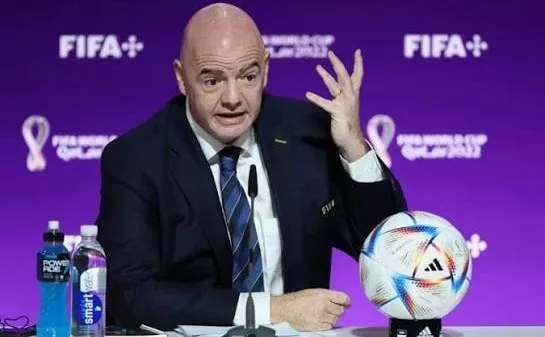
FIFA president Gianni Infantino has proposed an independent external review of the organisation’s governance framework, signalling a willingness to consider reforms following months of criticism over the abandoned FIFA Forward Enterprise investment plan.
In a letter sent to FIFA Council members and the presidents of all 211 member associations, Infantino said he would ask the Council to consider commissioning an independent review of how major strategic initiatives are developed and decided.
The proposal comes after intense opposition to the now-abandoned plan to sell a minority stake in FIFA’s commercial rights to private investors. The controversy has triggered wider discussions about transparency, accountability and the balance of power within world football’s governing body.
Infantino said the proposed review would examine FIFA’s current governance structure and identify possible improvements.
The consultation would involve FIFA’s six confederations, member associations and other relevant stakeholders.
Among the issues expected to be discussed are the respective roles of the FIFA president, Bureau, Council and Congress, as well as ways of strengthening transparency, participation and accountability when major strategic decisions are being considered.
Infantino has also invited stakeholders to submit proposals ahead of the FIFA Council meeting scheduled for October 15.
Any changes requiring amendments to FIFA’s statutes would ultimately need approval from the FIFA Congress.
The proposed review follows the collapse of the FIFA Forward Enterprise (FFE) initiative.
The plan involved exploring the sale of a minority stake in a FIFA-controlled commercial company holding rights connected to competitions including the World Cup.
Infantino has maintained that the proposal was never intended to surrender FIFA’s authority over sporting decisions.
He acknowledged, however, that the proposal entered the public domain before FIFA’s internal process had been completed, creating the impression that important decisions had already been made.
According to Infantino, the proposal was withdrawn after the backlash and will not proceed.
The controversy has also opened a broader debate over FIFA’s financial reserves.
UEFA president Aleksander Čeferin and CONCACAF president Victor Montagliani recently called for an independent review of FIFA’s reserves and proposed distributing at least $10 million to each of FIFA’s 211 member associations during the 2027–30 cycle.
Their proposal would amount to approximately $2.1 billion and would be separate from existing FIFA Forward funding.
The two confederation leaders argued that FIFA’s reserves could reach around $6 billion at the end of the current 2023–26 cycle, raising questions about whether external investment was necessary to increase development funding. They also called for an independent assessment of the figures before any final decision.
Pressure has also come from within FIFA’s own leadership structures.
Football Association chair and FIFA vice-president Debbie Hewitt has asked Infantino to release documentation relating to the abandoned investment plan and called for an independent review.
Her request adds to concerns from football officials who have questioned how the proposal was developed and communicated to FIFA’s governing bodies.
FIFA had already confirmed that a review of the withdrawn FFE proposal would be presented to its Council.
Despite the controversy, Infantino has said he remains committed to leading FIFA.
He is expected to seek a fourth term as president, with the next FIFA presidential election scheduled for March 18, 2027, in Rabat, Morocco.
The political situation within FIFA remains unsettled, however.
UEFA and several national associations have been calling for changes to FIFA’s leadership and governance. UEFA vice-president Laura McAllister said European football officials were working to identify a credible candidate and develop a broader reform programme.
The emerging debate goes beyond the abandoned investment proposal.
Critics of FIFA’s current structure have raised questions about the concentration of authority around the presidency, the transparency of major commercial decisions and the relationship between FIFA’s political and administrative structures.
The proposed consultation could therefore open discussions about:
Infantino has not committed to any particular model, instead proposing that different stakeholders present their views for consideration.
The FIFA Council’s October 15 meeting will provide an important opportunity for members to discuss the proposed governance review.
The outcome will help establish whether Infantino’s call for reform develops into a concrete process or remains primarily a consultation exercise.
The debate is also taking place only months before the 2027 presidential election, making governance reform a potentially important issue within FIFA’s membership.
The FIFA controversy has evolved from a dispute over one commercial proposal into a broader debate about how global football should be governed.
Infantino’s decision to propose an independent governance review represents a notable change in tone. However, the practical significance will depend on what the review examines, who conducts it, how transparent the process becomes and whether its recommendations lead to actual changes.
The financial debate is equally important for FIFA’s 211 member associations, particularly those that rely heavily on development and solidarity funding. UEFA and CONCACAF’s proposal for direct distributions has added another dimension to the discussion over how FIFA’s substantial reserves should be used.
For African football, the issue has particular significance. Many African member associations depend on FIFA development programmes to fund infrastructure, women’s football, youth development, training facilities and other projects.
The key question now is whether FIFA’s proposed review can produce a governance framework that gives member associations greater confidence in how major decisions are made while preserving the organisation’s ability to invest in football globally.
The October Council meeting should provide the first major indication of how far the reform discussion is prepared to go.
Follow the Afrcan360 Sports channel for more sports updates on WhatsApp: https://whatsapp.com/channel/0029VbCZkljKQuJTjRq4HZ0W