Physical Address
304 North Cardinal St.
Dorchester Center, MA 02124
Physical Address
304 North Cardinal St.
Dorchester Center, MA 02124

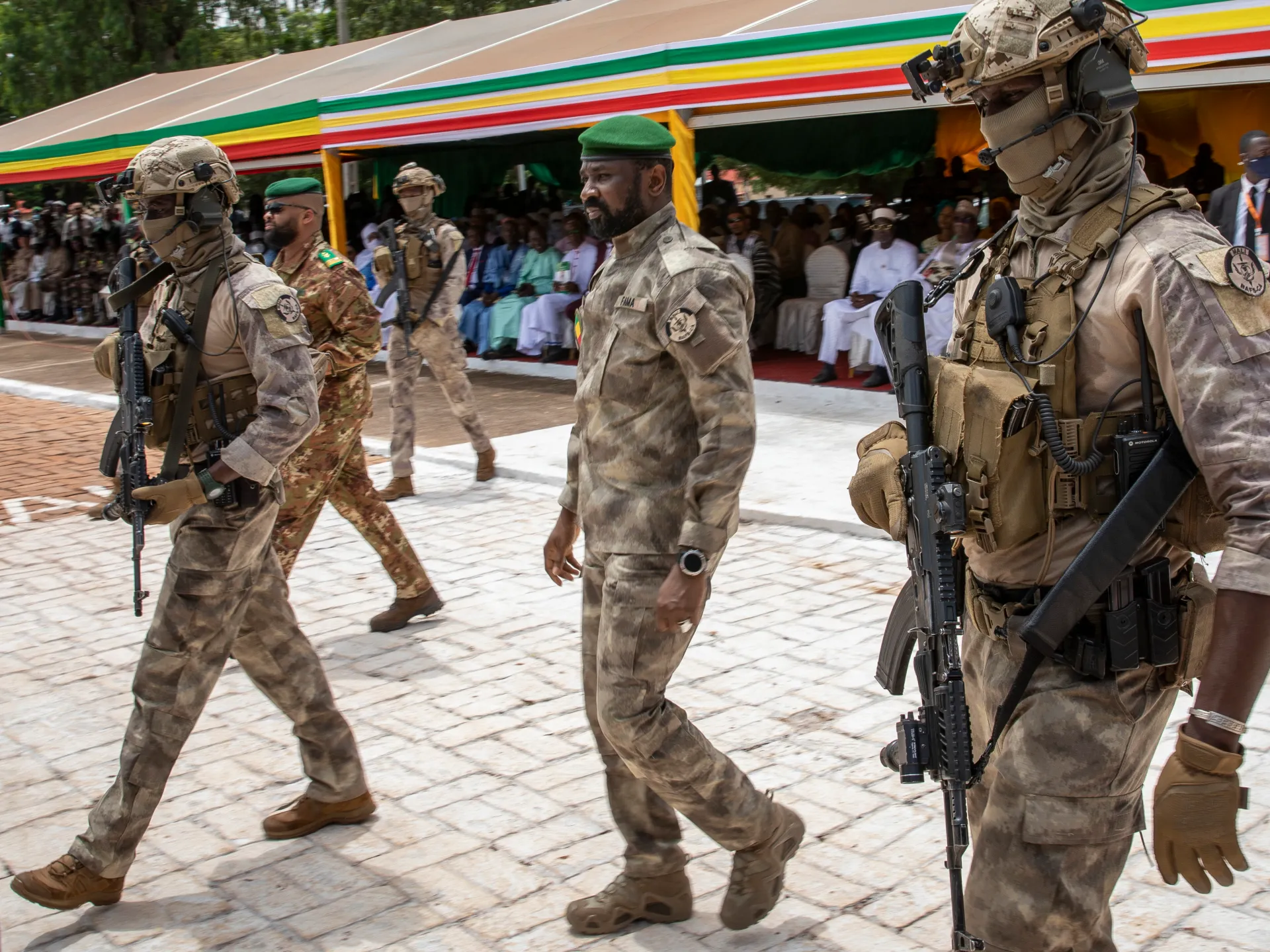
As Mali marks its independence anniversary, the country is confronting a security crisis that has moved beyond isolated attacks on military positions to threaten the movement of fuel, economic activity and the government’s ability to maintain control across its territory.
In Bamako, the arrival of more than 900 fuel tankers under military escort on September 14 offered temporary relief to a capital that has faced severe supply disruptions.
But the extraordinary security operation required to move the convoy into Bamako also revealed the scale of the challenge facing Mali’s military government: keeping the country’s vital economic corridors open while armed groups continue to operate across large parts of the country.
The crisis comes as Mali prepares to commemorate its independence on September 22.
On September 10, the al-Qaeda-linked Jama’at Nusrat al-Islam wal-Muslimeen (JNIM) attacked a Malian army camp in Dioura, central Mali.
The assault has become one of the most serious recent setbacks for Mali’s security forces.
JNIM claimed that 150 soldiers were killed and 93 captured. Those figures have not been independently verified. The Malian military confirmed that it suffered losses and said it launched air and ground operations around the garrison before evacuating troops.
Reuters, citing security and diplomatic sources, later reported that more than 100 Malian soldiers may have been killed in the attack, although the precise toll remains uncertain.
The significance of Dioura therefore extends beyond the reported casualty figures.
It demonstrated that JNIM retains the capacity to mount major assaults against government positions despite the junta’s repeated emphasis on strengthening national security.
Mali’s security crisis is not confined to military bases.
Since September 2025, JNIM has targeted fuel convoys and important highways linking Mali to ports and neighbouring countries.
Those attacks have disrupted the flow of petroleum products into Bamako and affected transportation, electricity generation and other economic activities.
FEWS NET reported that the country’s two main fuel corridors from Côte d’Ivoire and Senegal normally account for approximately 95% of Mali’s fuel supply.
That dependence gives armed groups an opportunity to exert pressure without having to capture the capital.
Instead of trying to occupy Bamako, they can attempt to make the capital increasingly difficult to supply.
The September 14 convoy of more than 900 tankers demonstrated both the government’s ability to respond and the vulnerability of the supply network.
Mali has been under military rule since the coups of 2020 and 2021.
The authorities have justified their political transition and foreign-policy realignment largely around the need to restore national sovereignty and improve security.
But the continuing attacks raise a difficult question:
How effectively can the state exercise sovereignty if armed groups can repeatedly disrupt roads, attack military installations and interfere with essential supplies?
The issue is particularly sensitive because the military government has made territorial control and national independence central themes of its political message.
Recent violence has therefore created a gap between the government’s sovereignty narrative and the security realities experienced in parts of the country.
Another important development is the increased coordination between JNIM and the Tuareg-led Azawad Liberation Front (FLA).
The two groups do not share the same ultimate political objective.
JNIM is an Islamist armed organisation affiliated with al-Qaeda and seeks to impose its interpretation of Islamic law.
The FLA, meanwhile, is rooted in longstanding Tuareg demands for greater autonomy or independence in northern Mali.
Their cooperation is therefore better understood as an alignment of interests against the Malian state rather than evidence that the two movements have merged politically or ideologically.
They have cooperated at various points in the past, but their relationship has also been undermined by competing territorial and ideological interests.
That makes the current coordination particularly significant for the government.
The September attack came after a major offensive in April involving JNIM and the FLA.
The offensive targeted military and strategic locations in and around Bamako, Kati, Mopti, Gao and Kidal.
The violence exposed weaknesses in the government’s ability to protect several strategic locations simultaneously.
The September Dioura attack has now added another major setback.
The broader regional trend is equally concerning. Conflict monitors have recorded a dramatic increase in militant violence across the central Sahel, with Mali, Burkina Faso and Niger experiencing some of the world’s highest levels of jihadist-related violence.
Since taking power, Mali’s military authorities have dramatically changed the country’s international security partnerships.
Bamako moved away from its previous cooperation with France and other Western partners and strengthened ties with Russia.
The Russian Wagner presence in Mali has also been replaced by the Russia-linked Africa Corps, which operates under Moscow’s defence ministry.
At the regional level, Mali joined Burkina Faso and Niger in creating the Alliance of Sahel States (AES).
The three countries subsequently withdrew from ECOWAS, with their withdrawal taking effect in January 2025.
The governments have presented these moves as part of a broader effort to reclaim sovereignty and determine their own security and economic policies.
However, the continuing violence means the effectiveness of the new security architecture remains under intense scrutiny.
Mali’s experience highlights a difficult distinction between political sovereignty and operational control.
A government can change its international partnerships, leave regional organisations and declare a new strategic direction.
But sovereignty also depends on whether the state can protect its roads, secure its borders, maintain public services and guarantee the movement of essential goods.
The fuel crisis has made that distinction particularly visible.
When hundreds of military vehicles and soldiers have to escort fuel tankers over long distances simply to keep the capital supplied, the country’s strategic vulnerabilities become difficult to ignore.
The security crisis has also created a humanitarian burden.
Displacement, disrupted livelihoods, insecurity around farming and grazing areas, and reduced access to essential services have affected communities across Mali.
The impact of the conflict is therefore not measured only by military casualties.
When fuel becomes scarce, transport costs rise. When roads become dangerous, food and other commodities become more expensive. When schools and public services are disrupted, communities lose opportunities that are difficult to recover.
The burden falls particularly heavily on people living far from Bamako and in areas where state institutions have limited reach.
For now, the Malian government has demonstrated that it can still protect major supply operations and respond militarily to attacks.
The September convoy reached Bamako, and the military has continued operations against armed groups around Dioura.
But the bigger challenge is maintaining that level of protection consistently across thousands of kilometres of roads and a vast national territory.
JNIM’s ability to strike military positions and interfere with economic corridors means the conflict is increasingly about more than holding individual towns.
It is about who controls movement, trade and access across the country.
Mali’s independence anniversary arrives at a particularly complicated moment.
The country’s military authorities have repeatedly presented sovereignty, national independence and control over domestic affairs as central objectives.
Yet the latest security developments demonstrate how difficult it is to translate political sovereignty into effective control on the ground.
The fuel blockade is particularly revealing.
An armed group does not need to capture Bamako to put pressure on the government. By attacking supply routes, it can create economic disruption, increase public anxiety and force the state to divert significant military resources towards protecting commercial corridors.
At the same time, the cooperation between JNIM and the FLA creates an additional strategic challenge because the government is facing armed actors with different motivations and geographic bases.
The situation does not necessarily mean that Bamako is on the verge of falling. Previous UN assessments have noted that JNIM did not have the capacity to occupy the capital, even while using the fuel blockade to pressure the government.
But Mali’s current reality demonstrates that controlling the capital is not the same as controlling the country.
The deeper test for Bamako will be whether its new alliances, military strategy and regional partnerships can restore reliable security along the roads, strengthen state institutions in vulnerable regions and reduce the humanitarian and economic costs of the conflict.
For ordinary Malians, independence ultimately means more than sovereignty speeches or military alliances.
It means being able to travel safely, find fuel, send children to school, farm without fear and conduct business without armed groups determining whether essential supplies can reach the capital.
That remains one of Mali’s greatest challenges as the country marks another year of independence.
oin African360 WhatsApp Channel for more News update: https://whatsapp.com/channel/0029Vb7Oc6nGk1FpdCN0xn44