Physical Address
304 North Cardinal St.
Dorchester Center, MA 02124
Physical Address
304 North Cardinal St.
Dorchester Center, MA 02124

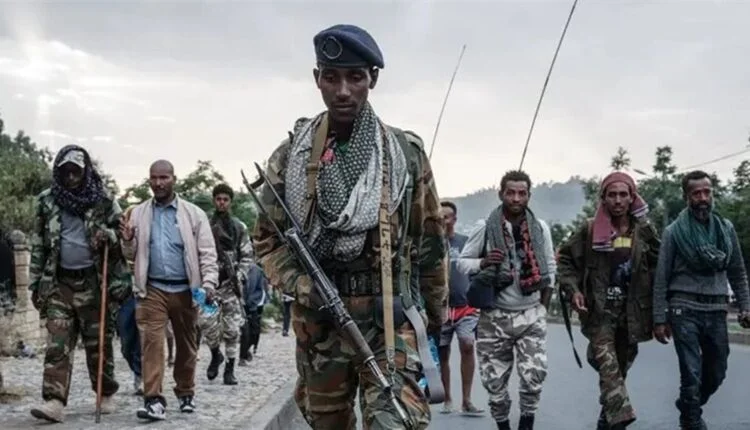
Seven Ethiopian armed and opposition groups have announced the formation of a new coalition aimed at removing Prime Minister Abiy Ahmed’s government and establishing an inclusive transitional administration.
The alliance, announced on Sunday, September 20, brings together some of Ethiopia’s most prominent armed movements, including the Amhara Fano National Movement, Oromo Liberation Army (OLA) and Tigray People’s Liberation Front (TPLF).
The coalition is calling itself the Ethiopian Peoples’ Forces Alliance for Survival, commonly referred to as the Alliance for Survival.
The announcement represents a significant development in Ethiopia’s continuing political and security crisis, particularly because several of the groups involved have previously been involved in separate conflicts and have had competing political interests.
According to the coalition’s statement, its members are:
The groups said they had agreed to work together despite their differences and eventually create a transitional political arrangement.
They also called on other Ethiopian political organisations, civic groups and members of the security forces to join what they described as a struggle for the country’s future.
The significance of the announcement lies partly in the backgrounds of the groups involved.
The Fano movement has been engaged in an armed insurgency against federal authorities in the Amhara region since 2023, after tensions escalated over the government’s decision to reorganise and disarm regional forces.
The OLA, meanwhile, has fought the federal government in Oromia since 2018.
The TPLF has an even more complicated relationship with Abiy’s administration. The party dominated Ethiopian politics for decades before Abiy came to power in 2018 and later fought a devastating two-year war against federal forces and their allies.
The 2022 Pretoria peace agreement brought that conflict to an end, but tensions between Tigray and the federal government have continued. Recent troop movements and political disputes have raised concerns about another escalation in the north.
Ethiopia has been dealing with armed violence across several regions.
The Oromia and Amhara conflicts have continued for years, while tensions involving Tigray have added another layer of uncertainty.
The inclusion of organisations from Oromia, Amhara, Tigray, the Somali region, Afar and Benishangul-Gumuz gives the alliance a geographic reach spanning several parts of the country.
However, forming a political and military alliance does not automatically mean that the groups have established a unified command or demonstrated the ability to conduct coordinated military operations.
That distinction could prove important because the organisations have different histories, political objectives and regional interests.
The coalition says its ultimate objective is not simply to remove the existing government but to facilitate a transitional administration.
In its founding statement, the groups said their differences should be addressed peacefully and that the future political order should reflect the freely expressed wishes of Ethiopia’s different peoples.
The alliance also called for participation from civic organisations and political groups that support its objectives.
The federal government had not publicly responded to the announcement in the latest reports available.
The announcement comes against the backdrop of renewed concerns about the 2020–2022 Tigray conflict.
That war resulted in enormous civilian suffering, mass displacement and widespread allegations of serious violations of international humanitarian and human rights law.
The African Union-backed Pretoria agreement ended the large-scale fighting in 2022, but unresolved political and territorial questions remain.
The AU has recently warned about increased tensions around Tigray, while both federal and Tigrayan forces have been reported to have strengthened their positions in the region.
A return to large-scale fighting in northern Ethiopia would have consequences far beyond Tigray, potentially affecting neighbouring Eritrea and the wider Horn of Africa.
The announcement creates a new political and security equation, but major questions remain about how the coalition would function in practice.
The groups have not publicly demonstrated a single military command structure capable of coordinating operations across Ethiopia’s different regions.
Their histories also include significant disagreements. Fano forces, for example, fought on the side of the federal government during the Tigray war, while the TPLF was the principal opponent of those forces.
Analysts quoted by AFP have therefore questioned whether the alliance can sustain a coordinated campaign against the federal government. At the same time, experts noted that simultaneous pressure across several fronts could create additional challenges for federal forces.
The alliance also emerges after Ethiopia’s latest general election, in which Abiy Ahmed’s Prosperity Party retained a dominant position in parliament.
The political process was nevertheless affected by the country’s security situation, with some opposition forces rejecting the election and Tigray excluded from the vote.
The emergence of a new armed coalition therefore adds another layer to an already complicated political environment in which questions about representation, regional autonomy, security and the future structure of the Ethiopian state remain deeply contested.
The formation of the Alliance for Survival is significant because it brings together armed movements from several major Ethiopian regions under a common political objective.
But the announcement should not automatically be interpreted as evidence that the government is about to fall.
The coalition still faces substantial questions over military coordination, political unity, command structures and what kind of government would follow a transition.
At the same time, the development highlights the depth of Ethiopia’s internal security challenges. A country of more than 100 million people is confronting armed conflicts with different origins across several regions, while unresolved tensions from the Tigray war remain a concern.
For the wider African continent, the situation deserves close attention. Ethiopia is one of Africa’s most strategically important states, and renewed nationwide conflict could have implications for neighbouring countries, humanitarian conditions, trade routes and security across the Horn of Africa.
The coming months will show whether the new alliance becomes a functioning political-military coalition or remains primarily a declaration of common opposition to the federal government.
Join African360 WhatsApp Channel for more News update: https://whatsapp.com/channel/0029Vb7Oc6nGk1FpdCN0xn44