Physical Address
304 North Cardinal St.
Dorchester Center, MA 02124
Physical Address
304 North Cardinal St.
Dorchester Center, MA 02124

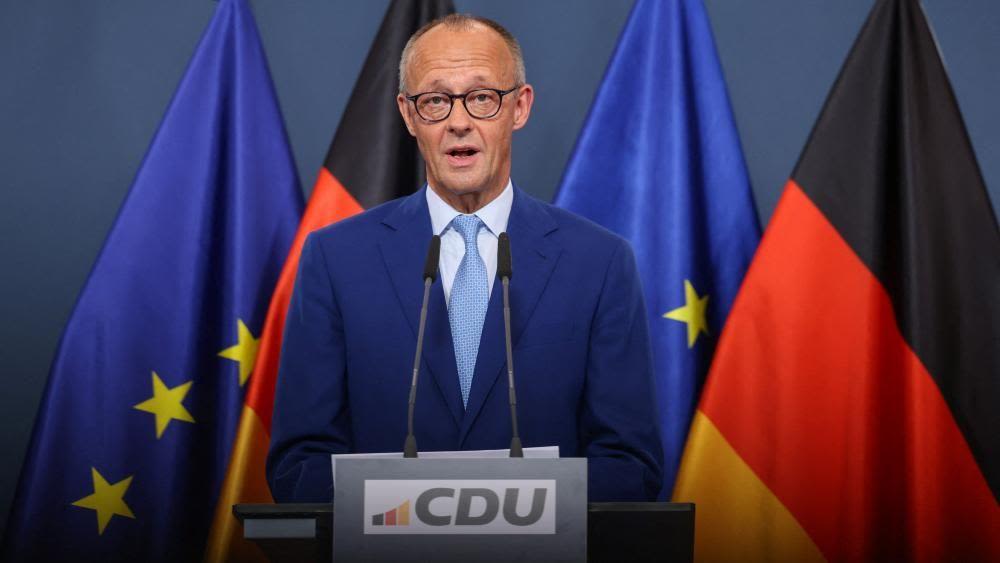
German Chancellor Friedrich Merz has vowed to remain in office and push ahead with his government’s reform programme after the Christian Democratic Union suffered historic defeats in two state elections.
German Chancellor Friedrich Merz has rejected speculation about his political future after his Christian Democratic Union (CDU) suffered a severe setback in elections in Mecklenburg-Western Pomerania and Berlin.
Merz described the CDU’s performance in Mecklenburg-Western Pomerania as a “disaster”, but insisted that he would remain Chancellor and continue pursuing his government’s economic, tax and welfare reforms.
The results represent the latest challenge for Merz, who has faced declining public support and growing questions about whether his coalition government can deliver its promised reforms.
The biggest blow came in Mecklenburg-Western Pomerania, where the CDU suffered its worst result in a state election since 1949.
The Alternative for Germany (AfD) finished first with about 38%, narrowly ahead of the centre-left Social Democratic Party (SPD), which took roughly 35.5%.
The CDU fell to around 5%, leaving it on the threshold required to win seats in the state parliament. Final figures put the party at approximately 4.9%, meaning it failed to clear the standard 5% threshold.
The result is particularly significant because the CDU is the party of the sitting German Chancellor.
Despite finishing first, the AfD is unlikely to enter government because Germany’s established parties have maintained a policy of refusing to form governing coalitions with it.
The CDU also suffered a major setback in the German capital.
Die Linke emerged as the largest party in Berlin’s state election with approximately 25.3%, while the CDU dropped to around 19%.
The AfD also increased its support in the capital, receiving roughly 16.3% of the vote.
The result means the CDU is set to lose its position as the leading force in Berlin’s state government, with coalition negotiations now expected to determine the next administration.
Die Linke’s campaign focused heavily on Berlin’s housing crisis, including proposals to expand rent controls and bring some privately owned housing under public ownership.
Despite the scale of the defeats, Merz has made clear that he does not intend to resign.
Speaking after the results, the Chancellor said Germany’s economic and structural reforms must continue.
He argued that the country needs “backbone, steadfastness and patience” and said he would demonstrate those qualities both as CDU chairman and as Chancellor.
Merz has linked his reform agenda to efforts to revive Germany’s sluggish economy and address problems including high living costs and pressure on the country’s welfare and pension systems.
The Chancellor also described his proposed reforms as an answer to what he called the growing appeal of authoritarian politics in German society.
The results provide another indication of the AfD’s growing electoral strength, particularly in eastern Germany.
The party’s first-place finish in Mecklenburg-Western Pomerania comes just weeks after it recorded a major victory in Saxony-Anhalt.
Its gains have intensified debate within Germany about the long-standing political “firewall” that has prevented the AfD from participating in governing coalitions.
The party has increasingly attracted voters concerned about immigration, the economy, energy costs and Germany’s relationship with Russia. Its growing support has also raised questions about how the established parties should respond.

The elections also reflected broader dissatisfaction with Germany’s economic situation.
Issues including energy prices, housing costs, economic stagnation and the impact of government reforms have become major concerns for voters.
In Berlin, the housing shortage and rising rents were particularly important campaign issues, with rents having risen substantially over the past decade and the city facing a significant shortage of homes.
For Merz, the challenge is therefore not limited to the CDU’s electoral performance. His government must also convince voters that its economic and social policies can address everyday financial pressures.
The latest results are likely to increase pressure within the CDU, although Merz has publicly rejected the idea of stepping down.
The Chancellor has been in office for less than a year and a half, and speculation about a possible leadership change had already emerged following earlier regional election setbacks.
Eight German state premiers had publicly backed Merz before Sunday’s elections, signalling support for his continued leadership.
The latest defeats, however, create a more difficult political environment for the Chancellor as he attempts to push controversial reforms through the federal government.
The elections have produced a complicated political picture for Germany.
The CDU has suffered major losses, while both the AfD on the right and Die Linke on the left have made significant gains in different parts of the country.
That does not automatically translate into a change of federal government. Germany’s federal government remains in place, and the regional elections do not directly determine who serves as Chancellor.
But the results do provide a measure of voter sentiment and create additional pressure on Merz to demonstrate that his government’s policies can deliver tangible improvements.
The AfD’s continued electoral growth is particularly significant because other major parties remain unwilling to form coalitions with it. That means strong election results do not necessarily translate into governing power.
For Merz, the immediate task is therefore twofold: maintain political support within his own party while delivering on the economic and social reforms he says Germany urgently needs.
The next phase of German politics will show whether the CDU can recover from these regional defeats or whether the country’s political landscape will continue to fragment between competing forces on the left and right.
Join African360 WhatsApp Channel for more News update: https://whatsapp.com/channel/0029Vb7Oc6nGk1FpdCN0xn44